Introduction
A credit decision can set the terms of a customer’s financial relationship with a bank for years. That makes the explanation behind the decision more consequential than a routine notice.
In the US, ECOA and Regulation B require creditors taking adverse action to provide specific reasons, and the CFPB has made clear that sophisticated algorithms do not exempt lenders from that obligation. In the EU, the AI Act places AI systems used for creditworthiness assessment and credit scoring within its high-risk framework.
The regulatory direction is clear: credit decisions need an intelligible trail back to their reasons.
Compliance asks:
Did we disclose the required information accurately and consistently?
CX asks:
Can the customer understand what happened and what it means for them?
The same communication must address both questions.
A Credit Decision Is Only as Clear as Its Explanation
A customer does not experience the underwriting model, the decision engine, or the internal workflow that produced a credit outcome. They experience the communication that arrives afterward. That message has a difficult job: convey a consequential decision without making the customer decode the institution’s internal language.
Clarity, therefore, is not the same as simplifying everything. A useful explanation preserves the substance of the decision while removing the ambiguity surrounding it.
| Communication element | What the customer needs | Customer-friendly example | What to avoid |
| Decision | A direct, unambiguous outcome | We’re unable to approve your loan application at this time. | Your application has been processed. |
| Reason | A clear explanation of the relevant factor | Your application was not approved because your recent payment history did not meet the requirements for this loan. | Adverse credit profile. |
| Context | Enough information to understand what influenced the decision | Your application was reviewed using the information you provided and your credit history. | Decision based on our internal assessment. |
| Next step | Practical guidance on what the customer can do | If you believe any information in your credit report is incorrect, you can contact us to discuss the information used in your application. | Contact customer service for further assistance. |
The distinction matters because a technically complete communication can still leave a customer with unanswered questions. Transparency has greater value when the explanation helps the recipient understand not only what the bank has decided but also why the decision matters to them.
That brings us to the substance of the explanation itself: what information should a transparent credit communication contain?

4 Key Strategies for Achieving Consistent Customer Communications and Impactful Interactions
Why Transparency Matters Beyond Regulatory Compliance
For banks, transparency has two completely unique audiences, and both have a legitimate claim on the explanation.
In the US, ECOA and Regulation B require creditors taking adverse action to provide specific reasons for the decision. The CFPB has also made clear that this obligation does not disappear when a lender uses complex algorithms or other advanced technology. Generic statements such as “our internal standards were not met” are not sufficient; the reasons need to relate to the factors considered in the decision.
The EU adds another dimension. Under the AI Act, AI systems used to evaluate the creditworthiness or credit score of natural persons are classified as high-risk, subject to the regulation’s conditions and exceptions. Where automated decision-making falls within GDPR Article 22, EU case law has also addressed the individual’s right to meaningful information about the logic involved, requiring explanations that are relevant, concise, transparent, intelligible, and accessible.
The reason behind these requirements goes beyond satisfying a disclosure checklist.
Transparency Gives Customers Something They Can Act On
A credit decision can affect whether someone buys a home, obtains financing, refinances existing debt, or changes their financial plans. Knowing that an application was declined is one thing. Knowing the principal factors behind that outcome gives the customer a basis for understanding the decision and, where appropriate, correcting inaccurate information or considering what to do next. The CFPB itself identifies consumer protection and consumer education among the purposes of adverse-action notices.
Transparency Makes the Bank’s Own Decisioning More Accountable
There is another audience inside the institution: compliance, operations, risk, and customer-service teams.
A bank that can consistently explain its credit decisions has to maintain alignment between the data used, the decisioning process, the reasons produced, and the communication sent to the customer. That creates a stronger evidentiary trail when a decision is questioned or reviewed.
Clarity Can Strengthen the Customer Relationship
A declined application will not become a positive experience simply because the explanation is well written. But a specific, comprehensible explanation can remove a second source of frustration: not knowing what happened.
That is where compliance and CX converge. The same communication that demonstrates that a bank can account for its decision can also demonstrate that it respects the customer’s need to understand it.
The challenge is turning that principle into a repeatable communication process, particularly when credit decisions vary across products, customers, channels, and decisioning systems.
How Banks Can Build Transparency into Credit Communications
Transparency cannot be added at the end of the credit process as a final copywriting exercise. The explanation needs to be connected to the decision from the point at which the decision is generated.
For banks, that means establishing a communication process in which decision data, business rules, approved content, compliance requirements, and customer context remain connected.
The objective is straightforward: when a credit decision is communicated, the explanation should reflect the factors that produced that decision, use language the customer can understand, and remain consistent with the institution’s disclosure requirements.
1. Connect the Explanation to the Actual Decision
A transparent explanation begins with the information that influenced the decision. If the decision engine identifies income, payment history, credit utilization, debt-to-income ratio, or another relevant factor as material to the outcome, the communication process needs access to that information. A separate, manually maintained explanation layer creates room for discrepancies between what the bank used to make the decision and what it tells the customer afterward.
Banks should establish a clear connection between:
- Decision inputs: The data considered during the credit assessment
- Decision outcome: The approval, decline, limit, pricing, or other result
- Reason codes: The factors that explain the outcome
- Communication rules: The conditions determining which reasons and disclosures appear
- Customer-facing content: The approved language used to communicate the decision
This connection also makes changes easier to govern. When decision rules, regulatory requirements, or approved language change, you can review the corresponding communication logic without rebuilding every document from scratch.
2. Turn Complex Decision Logic into Clear Customer Language
A bank’s internal decisioning terminology is designed for systems, analysts, risk teams, and compliance functions. It is not automatically suitable for customers.
The communication layer therefore needs to translate decision outputs into language that preserves meaning without exposing the customer to internal system terminology.
| Internal output | Customer-facing approach |
| High debt-to-income ratio | Explain that the customer’s existing debt relative to income did not meet the requirements for the application |
| Insufficient credit history | Explain that there was not enough credit history available to meet the applicable criteria |
| Payment history outside policy criteria | Explain that recent payment history did not meet the requirements considered for the application |
| Internal risk score below threshold | Avoid presenting an unexplained score as the reason; communicate the relevant factors required by the applicable disclosure rules |
A customer-friendly explanation is not a generic sentence inserted after the decision has been made. It is a governed interpretation of the decision output.
3. Separate What Must Be Disclosed from What Helps the Customer Understand
Regulatory requirements establish a baseline. Customer experience requires the bank to think beyond that baseline without compromising it.
Credit communication can therefore be structured in layers:
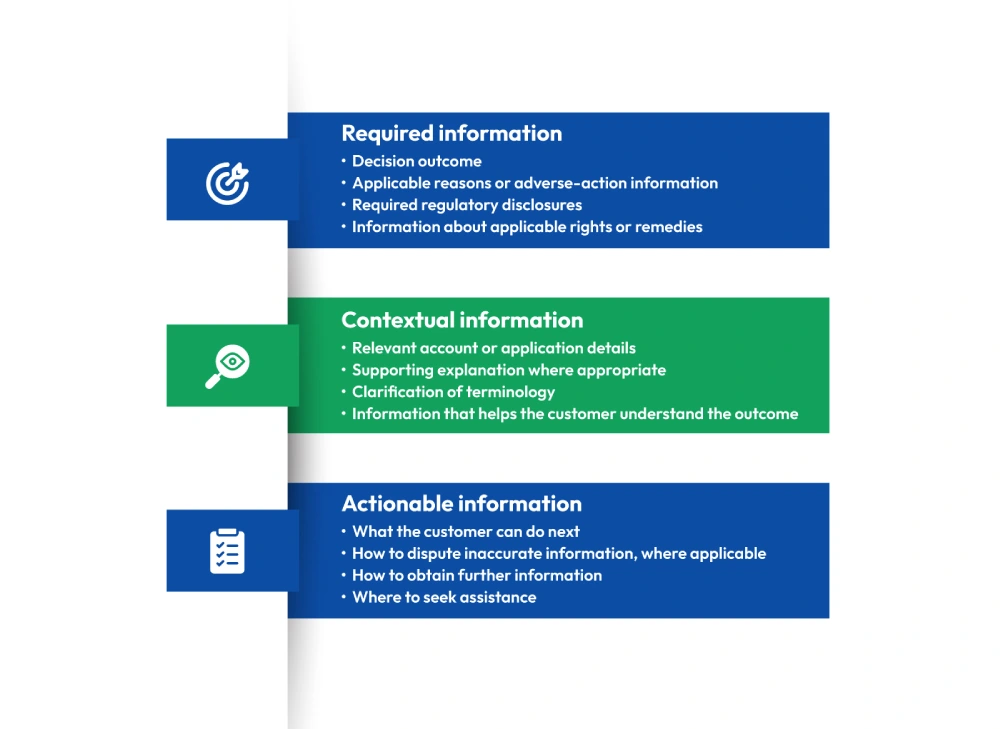
The distinction between required information and explanatory content should not create two separate layers of communication. They need to work together.
A customer should be able to identify the decision, understand the principal reason behind it, and find the disclosures or rights that apply to that decision without having to piece the information together themselves. The regulatory information provides the necessary detail; the explanatory content gives that detail enough context to be understood.
For banks, the practical task is to structure the communication so that compliance requirements support the explanation rather than interrupting it.
4. Keep Explanations Consistent Across Channels
A customer should not receive one explanation in a letter and a materially different version in an email, portal notification, or conversation with a service representative.
That requires banks to treat the explanation as governed content rather than channel-specific copy.
A centralized communication framework can establish:
One decision → One governed explanation → Multiple delivery formats
The presentation can change by channel. The underlying meaning should not.
For example, a detailed adverse-action letter can contain the complete required disclosure, while a digital notification can direct the customer to the relevant document. A service representative can access the same approved explanation when responding to a question.
Centralized content management helps maintain this consistency by giving teams a controlled source for approved language, while workflow rules can determine which content components belong in each communication.
5. Make Every Explanation Traceable
Transparency has an internal dimension as well. If a customer challenges a credit decision, the bank needs to understand not only what was communicated, but how that communication was produced.
A traceable process should make it possible to identify:
- The decision or servicing event that triggered the communication
- The relevant data used to populate the document
- The reason codes or business rules that influenced the explanation
- The content version used
- Any applicable compliance or approval workflow
- The channel through which the communication was delivered
- The date and time of generation and delivery
This creates an evidentiary chain between the decision and the explanation.
For regulated institutions, that chain matters because transparency is not demonstrated by producing a well-written letter after the fact. The bank needs confidence that the explanation sent to the customer corresponds to the decision that was made and the rules that governed it.
From Decision Logic to Customer Understanding
These practices point to a broader operational requirement. Banks need the ability to move information through the entire communication chain without losing its meaning along the way.
Decision data → Reason identification → Business rules → Approved content → Personalization → Compliance checks → Delivery → Audit trail
When those stages operate as disconnected processes, transparency depends heavily on manual interpretation. When they are connected, the explanation can become part of the credit communication architecture itself.
That is where Customer Communications Management (CCM) becomes relevant. The bank does not need another isolated document-generation process. It needs a controlled communication layer capable of taking decision information and turning it into accurate, understandable, and traceable customer communications.
Building the Explanation Part of the Credit Decision
A credit decision does not become transparent simply because the bank has disclosed the required information. The customer needs to understand what happened, why it happened, and what the decision means for them. That requires the explanation to be treated as part of the credit communication process itself. Decision data, business rules, approved content, compliance requirements, and delivery channels need to work together so that communication remains accurate, understandable, and traceable.
CCM provides the infrastructure to make that possible. With Cincom Eloquence, banks can connect data and decision information with governed content, automated workflows, compliance controls, personalized document generation, and omnichannel delivery. Audit trails provide visibility into how communications were produced and delivered, while centralized content management helps maintain consistency across customer touchpoints.
The result is a communication process designed to preserve both sides of the transparency mandate: the bank can demonstrate why a decision was communicated in a particular way, and the customer can understand what the decision means for them.
Make every credit decision easier to understand.
Explore how Cincom Eloquence can help banks deliver transparent, compliant customer communications.
FAQs
1. Why is transparency important in credit decisions?
Transparent explanations help customers understand why a credit decision was made, what information influenced it, and what they can do next. They also help banks meet disclosure and compliance requirements.
2. What information should a credit decision explanation include?
It should clearly communicate the decision, the relevant reasons behind it, applicable regulatory disclosures, and any appropriate next steps or customer rights.
3. How can banks make credit decision communications easier to understand?
Banks can translate decision outputs and regulatory requirements into clear customer-facing language while keeping the underlying meaning and required disclosures intact.
4. How does CCM software support transparent credit communications?
CCM software connects decision data, business rules, approved content, compliance workflows, and delivery channels to produce consistent and traceable customer communications.
5. How can Cincom Eloquence help banks deliver transparent credit communications?
Cincom Eloquence helps banks generate personalized, compliant credit communications by connecting data with governed content, automated workflows, omnichannel delivery, and audit trails.