Introduction
The most personalized loan communication may be the one the borrower never expected to receive.
Not because the lender knows the borrower’s name or remembers their last interaction, but because something changed. A payment was missed. A hardship request was approved. An escrow amount shifted. A payoff figure was requested. The event changes what the borrower needs to know and, consequently, what the lender should say. This approach is the foundation of hyper-personalized loan servicing communications.
That is where hyper-personalization becomes interesting in loan servicing. The raw ingredients already exist across servicing systems. The harder task is making those signals influence the communication itself while keeping every required piece of content governed and traceable.
The question, then, is not how to personalize loan communication. It is how to design the machinery that makes each communication responsive to the loan’s changing reality.
What Hyper-Personalization Looks Like Across the Loan Lifecycle
A borrower’s circumstances do not remain fixed between one servicing event and the next. The communication architecture needs to account for those shifts, bringing together the signals that matter at a given point in the journey.
A useful way to think about hyper-personalization is through four inputs that shape communication. Together, these inputs support automated document generation for the loan lifecycle that responds to the borrower’s changing circumstances.
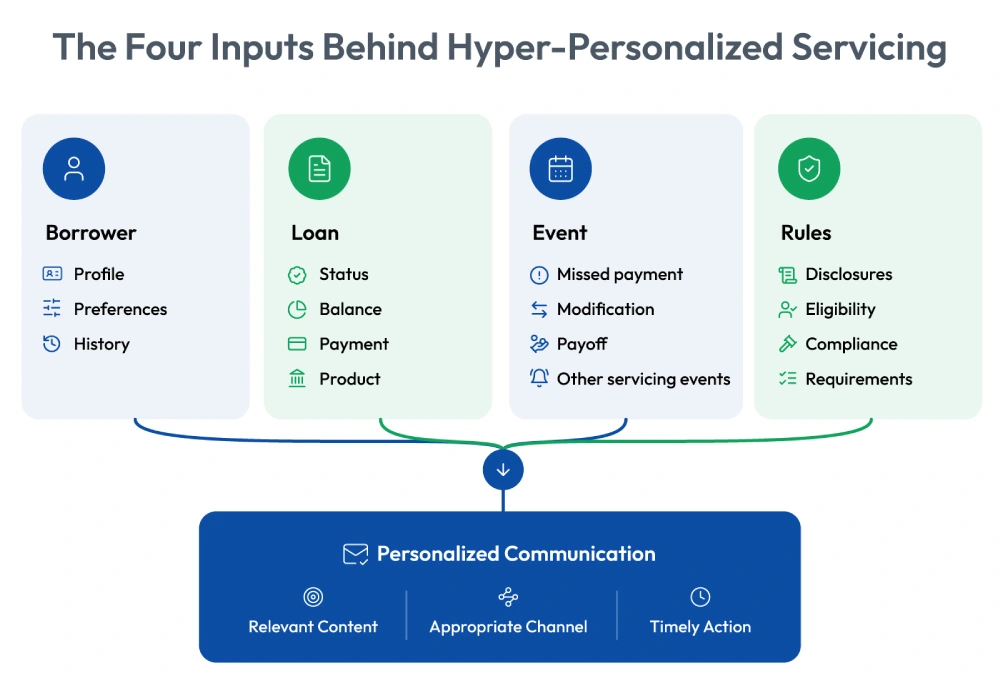
The value emerges when these inputs work together. A servicing event can change the borrower’s circumstances, the loan data can provide the necessary context, and business rules can determine what can or must appear in the final hyper-personalized loan servicing communications.
That sets the foundation for the practices that follow. The first is deceptively simple: personalization needs to begin with the loan itself, not just the person attached to it.

Automate Financial Services Document Generation
Discover how to build a centralized CCM framework that connects data, validation, compliance, and delivery to generate accurate customer documents at scale.
7 Best Practices for Hyper-Personalizing Loan Servicing Communications
Hyper-personalization becomes useful when it changes the substance of a servicing communication, not simply its appearance, which indicates looking beyond the borrower’s profile and considering the loan, the event that triggered the communication, the rules that govern it, and the context carried over from previous interactions.
The following practices can help lenders build that level of precision into the communication journey.
1. Personalize to the Loan, Not Just the Borrower
A borrower’s name tells a communication system very little. The loan attached to that name tells it considerably more.
A customer with two loans may have different balances, payment schedules, statuses, preferences, and servicing histories for each account. Treating both relationships as one customer record can produce communications that are technically personalized but contextually misplaced.
Loan-level data should therefore have a direct role in determining communication content. Relevant attributes can include:
- Loan type and product
- Current balance and payment amount
- Payment status and history
- Interest rate or rate changes
- Delinquency status
- Modification or assistance status
- Maturity or payoff information
The result is a communication built around the account that requires attention, rather than a generic message attached to a customer profile.
2. Let Servicing Events Shape the Next Communication
The most useful personalization signal may be something that happened moments ago.
A payment received, missed installment, approved modification, submitted document, or change in account status can alter what the borrower needs to know next. Instead of treating these events as triggers for a fixed template, lenders can use them to determine the structure and content of the communication, supporting automated loan lifecycle document generation that reflects the borrower’s current servicing context.
| Servicing event | Communication can respond with |
| Payment received | Updated balance, receipt details, next payment information |
| Missed payment | Amount due, available actions, relevant assistance information |
| Modification approved | Revised terms, effective date, next steps |
| Document submitted | Confirmation, outstanding requirements, expected next action |
| Payoff requested | Payoff amount, validity period, instructions |
This turns the lifecycle itself into a personalization signal.
3. Make Data Decide What Belongs in Communication
More data does not automatically produce better personalization. The important question is what the communication engine does with that data.
A well-designed approach establishes relationships between data points and communication decisions. For example, a borrower’s status could determine which explanation appears, while jurisdiction could determine which disclosure accompanies it.
Think of the process as:
Data → Rules → Content decision → Communication
This can influence:
- Which content components appear
- Which version of a message is used
- What information requires emphasis
- Which disclosures are included
- What action is the borrower asked to take
- Which content should be excluded
Communication becomes an output of business logic rather than a document that happens to contain customer data.
4. Keep Personalization Within Clearly Governed Boundaries
Personalization introduces flexibility. Loan servicing requires control. The two need to coexist within the same communication framework. Not every element of a document should be available for dynamic alteration. Some content may be borrower-specific, while other elements require approved wording, version control, or jurisdiction-specific treatment, all of which are essential to compliant borrower communication management.
A practical model is to separate the communication into two layers:
| Personalized layer | Governed layer |
| Borrower details | Required disclosures |
| Account information | Approved legal language |
| Payment information | Regulatory statements |
| Relevant instructions | Controlled content |
| Context-specific explanations | Version-controlled templates |
This allows lenders to tailor the communication where it adds value without losing visibility over the content that demands tighter governance.
5. Carry Context from One Interaction to the Next
A borrower should not have to start from zero every time a new communication arrives.
Consider a borrower who has already submitted documentation for a modification. A subsequent communication should reflect that history rather than treating the borrower as though they have just entered the process.
This requires communication systems to account for relevant interaction history, such as:
Previous communication → borrower response → servicing update → next communication
The benefit extends beyond convenience. Carrying context forward can reduce contradictory messages, repeated requests for information, and unnecessary friction during lengthy servicing processes.
6. Personalize the Channel Alongside the Content
A personalized message delivered through an unsuitable channel loses some of its value.
Channel selection can take into account the nature of the communication, borrower preferences, urgency, and the type of information being delivered. The same servicing event may therefore result in different delivery experiences without changing the underlying information.
For example:
| Communication need | Possible delivery approach |
| Routine account update | Email or digital portal |
| Immediate payment reminder | SMS + digital communication |
| Detailed servicing document | Portal or document delivery |
| Formal notice | Print or approved digital channel |
Here, the objective is not to create a different message for every channel but to preserve the communication’s context while adapting its delivery to the interaction.
7. Make Every Personalized Communication Traceable
The more variables influence a communication, the more important its provenance becomes.
If a servicing document was assembled from borrower data, loan information, business rules, content components, and approval workflows, the lender should be able to reconstruct how that document came together.
A robust communication process should provide visibility into:
- What was generated
- Which data influenced it
- Which rules were applied
- Which content version was used
- Who approved it, where applicable
- Where and when it was delivered
This creates an important foundation for governance. Hyper-personalized loan servicing communications do not become a black box simply because the final document looks different for every borrower. Their underlying decisions remain observable and accountable.
The Technology Architecture Behind Hyper-Personalized Loan Communications
Customer Communications Management (CCM) software provides the layer that connects loan data, content, business rules, workflows, and delivery channels. For lenders, CCM software for mortgage and lending can turn information from existing systems into relevant, governed communications while supporting automated loan lifecycle document generation at scale.
- Connect Data to Communication Generation
CCM can bring relevant borrower, loan, and servicing data into the communication process, allowing documents to reflect the account’s current status and servicing event without manual intervention. - Embed Business Rules and Compliance Controls
Business rules can determine the content, disclosures, instructions, and approval paths applicable to a borrower, loan, jurisdiction, or event. This supports compliant borrower communication management without restricting useful personalization. - Manage Reusable Content
Instead of creating a separate template for every variation, lenders can use governed content components that are assembled according to the communication’s context. This reduces template proliferation while maintaining content control. - Orchestrate Delivery Across Channels
Email, print, SMS, and digital portals can draw from the same underlying content and rules, allowing lenders to maintain continuity across channels without managing disconnected communication processes. - Use Generative AI Where It Adds Practical Value
Generative AI can assist with targeted tasks such as rephrasing and multilingual translation, extending content capabilities while keeping core content, rules, and approvals within the CCM environment. - Maintain Traceability
A CCM platform should provide visibility into the data, rules, content versions, approvals, and delivery details behind each generated communication. This makes personalized communications easier to govern, review, and reproduce when required.
Turning the Architecture into Action with Cincom Eloquence
The difference between personalization that looks good on paper and personalization that works in servicing comes down to integration. Borrower and loan data need to reach the communication process at the right moment, while content, business rules, workflows, and delivery remain connected.
This is where Cincom Eloquence can fit into the lending technology landscape. Its CCM capabilities integrate with loan servicing platforms to help generate hyper-personalized loan servicing communications, including borrower notices, statements, and disclosures, while maintaining the controls required for regulated communications.
Centralized content management, workflow automation, omnichannel delivery, and audit trails provide the foundation. Generative AI capabilities can further assist teams with tasks such as rephrasing and multilingual translation.
Make every loan communication more relevant.
See how Cincom Eloquence can help connect your lending systems with personalized, compliant communications.
FAQs
1. How does Cincom Eloquence integrate with existing loan servicing platforms?
Cincom Eloquence lending CCM integration connects communication workflows with existing loan servicing systems, allowing relevant borrower and loan data to drive personalized documents without replacing core platforms.
2. What is the difference between mail merge and CCM software for mortgage and lending?
Mail merge primarily inserts data into predefined documents. CCM software for mortgage and lending can combine data, business rules, reusable content, workflows, and delivery channels to support more sophisticated personalization and governance.
3. How can lenders personalize borrower communications while maintaining compliance controls?
Lenders can use governed templates, conditional rules, approved content, workflows, and audit trails to create compliant borrower communication management while still tailoring communications to individual loan circumstances.
4. How does conditional logic personalize loan servicing notices and modification letters?
Conditional logic evaluates information such as loan status, borrower attributes, jurisdiction, or servicing events to determine which content, disclosures, and instructions appear in a communication.
5. Can Cincom Eloquence deliver personalized communications across print, email, SMS, and digital portals?
Yes. Cincom Eloquence supports omnichannel delivery, allowing lenders to distribute hyper-personalized loan servicing communications across print and digital channels using consistent underlying content and business rules.
6. How does hyper-personalization work across different stages of the loan lifecycle?
It uses changing borrower, loan, and servicing data to adapt communications as the account moves through stages such as approval, repayment, delinquency, modification, and payoff. This supports automated loan lifecycle document generation based on the context of each event.
7. Why use CCM software for loan servicing instead of relying on manual template management?
CCM software can centralize content, automate document generation, apply business rules, manage approvals, and maintain traceability. This gives lenders greater control as communication volumes and personalization requirements grow.