The 2026 Compliance Paradox: High Tech, Higher Stakes
The banking sector is currently facing a startling contradiction. In the first half of 2025, global regulators issued 139 penalties totaling approximately $1.23 billion—a 417% increase compared to the previous year. This surge creates a frustrating paradox: banks have invested more in “smart” software than at any point in history, yet they are more vulnerable to fines than ever before.
This discrepancy exists because most institutions have treated compliance as a back-office data problem. They have built fortresses around their internal databases but left their customer-facing interactions in disarray. While a bank might have an impeccable system for monitoring transactions, it often relies on fragmented, manual processes to send out the actual disclosures, notices, and alerts that regulators demand.
In 2026, the final point of contact where a bank communicates with its customer is where the most expensive risks reside. It does not matter how sophisticated your internal risk engine is if the final message reaching the customer is inaccurate, delayed, or missing a required disclosure. With banks already juggling the complexities of Basel III, SOX, and FFIEC, the pressure to bridge this gap has become an operational imperative. To solve the paradox, banks must stop viewing compliance as a silent data exercise and start seeing it as a front-end communication reality.
What is Bank Compliance Software?
Bank compliance software is a specialized category of technology designed to automate and unify the way a financial institution adheres to laws, regulations, and internal policies. While many view it as a simple monitoring tool, it is more accurately described as an operational nervous system. It connects the bank’s internal data with the ever-evolving rulebooks of global and local regulators.
The functionality of this software has shifted from passive record-keeping to active prevention. It provides a centralized platform where compliance teams can manage the entire regulatory lifecycle from the moment a new law is drafted to the final proof that the bank has implemented it.

Safeguard Your Client Relationships: Mitigate Risks with a Modern Customer Communication Compliance Solution
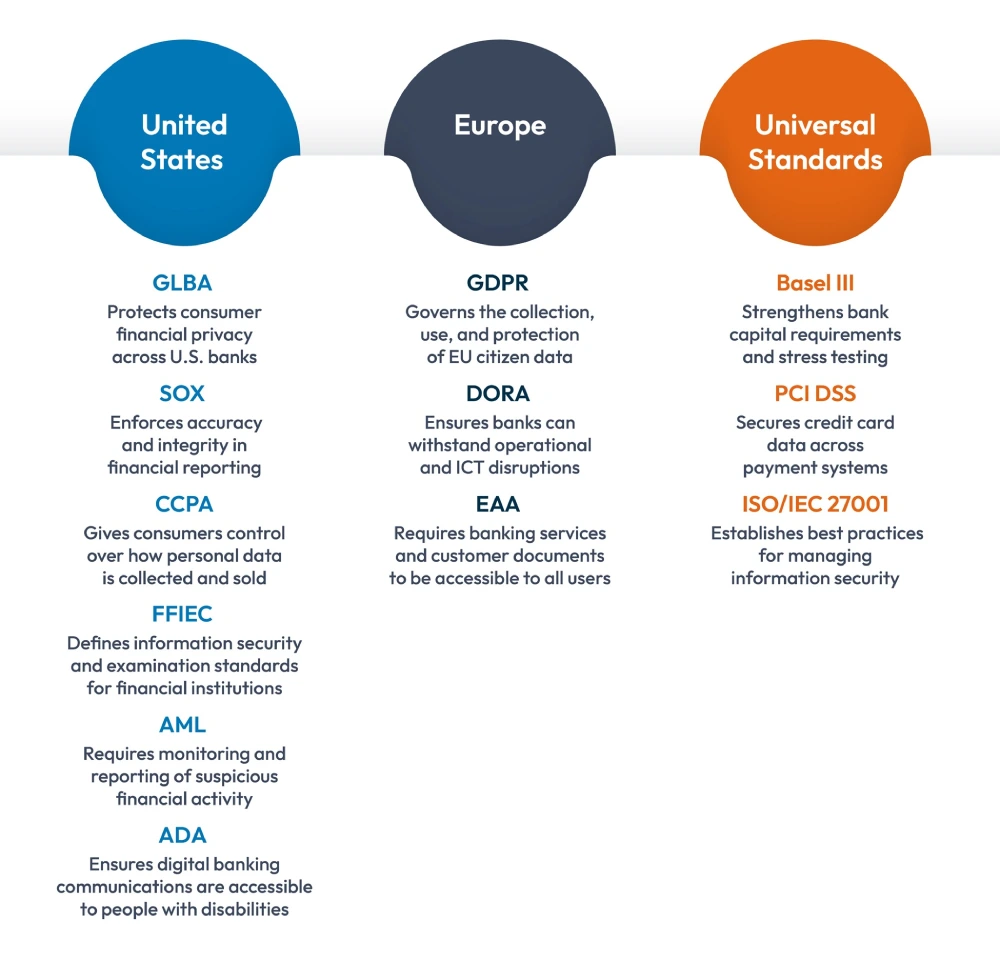
Primary Mandates in the USA and Europe
For a bank’s compliance software to be effective, it must fluently speak the language of multiple jurisdictions. In 2026, the following regulations form the bedrock of financial oversight across the globe:
The Critical Role of Bank Compliance Software
Relying on manual processes to translate complex mandates into customer communications creates significant operational risk. Automated regulatory disclosure management bridges the gap between back-office data and front-end delivery, ensuring that every interaction remains within legal boundaries.
The Point-of-Delivery Vulnerability
Modern risk engines often focus exclusively on internal data, creating a false sense of security. However, compliance frequently fails at the final point of contact. If a disclosure is inaccurate or delivered through an insecure, unencrypted channel, the bank remains legally exposed.
- Encrypted Delivery: Securing the “final touch” ensures that sensitive PII (Personally Identifiable Information) is never exposed during transmission, meeting strict standards.
- Verification of Receipt: Beyond just sending a notice, specialized bank compliance software provides an immutable log (a digital receipt) showing exactly when a customer accessed a document.
- Mitigation of Human Error: Automating the delivery path removes the risk of a staff member manually sending the wrong version of a document to a client.
Deterministic vs. Rule-Based Accuracy
In the rigorous world of legal documentation, there is no room for “best guesses.” Systems that predict or dynamically generate text based on patterns introduce a high risk of catastrophic errors in legal terminology.
- Pre-Approved Logic: A deterministic system uses strict “if-then” logic to ensure that only legally vetted clauses are inserted into documents based on the customer’s specific profile.
- Zero-Variance Output: Whether you generate one statement or one million, the legal language remains identical and compliant every single time, eliminating the “drift” found in more fluid systems.
- Explainable Compliance: Regulators prefer rule-based systems because the “why” behind every communication is easy to audit, unlike black-box models that cannot explain their choice of words.
| Feature | Probabilistic Systems | Deterministic (Rule-Based) |
| Accuracy | High, but unpredictable | Absolute and repeatable |
| Legal Risk | High (potential for errors) | Zero-variance legal text |
| Audit Path | Opaque and difficult to trace | Fully transparent and coded |
Dynamic Content Management & Omnichannel Consistency
Compliance requires the ability to push instant, cross-channel updates the moment a regulation changes. Whether a customer is viewing an email, an SMS, or a mobile app notification, the message must be identical and current.
- Single-Source Publishing: Update a legal footer or a disclosure once in the central system, and it propagates to every digital and print channel immediately.
- Elimination of Silos: Centralized management prevents the common issue where a mobile app shows one set of terms while the printed statement shows another.
- Version Control: Every change is timestamped and tracked, allowing the bank to prove exactly which version of a document was live on any given date for any specific customer.
Customer Consent & Transparency
Modern mandates have shifted the focus toward the customer’s right to clarity. It is no longer sufficient to merely “provide” information; banks must now document digital consent and provide real-time alerts for all account activities.
- Active Consent Tracking: Software captures and stores a customer’s “click-to-accept” as a legal record, meeting the requirements of privacy laws and ensuring consent is reflected consistently across omnichannel bank statements and digital communications.
- Real-time Transparency: Instant alerts for transaction thresholds or account changes serve as both a fraud deterrent and a mandatory transparency requirement.
- Accessibility Standards: Automated tools ensure that every digital communication meets ADA and EAA standards, making it readable for users with disabilities across all platforms.
Data Sovereignty and Supply Chain Security
As banks become more interconnected, the risk of data being processed in unauthorized jurisdictions increases. Compliance software must ensure that sensitive financial data remains under the bank’s jurisdictional control.
- Geofencing Data Flows: Advanced software ensures that customer data never leaves the required legal borders, such as keeping EU resident data within the European Economic Area.
- Cryptographic Control: The bank, not the software provider, should hold the encryption keys. This ensures that even if a vendor is compromised, the bank’s core data remains sovereign and unreadable to outsiders.
- Third-Party Oversight: By centralizing communications, banks can vet the security of the entire document lifecycle, reducing the risk of a “supply chain” breach where a third-party printer or email host accidentally leaks data.
Simplifying Compliance and Efficiency for a 150-Year-Old Property and Casualty Insurance Provider
Best Practices for Audit Readiness and Future-Proofing
The objective of modern compliance is to eliminate the frantic “manual scramble” that traditionally precedes a regulatory examination. When an institution maintains a state of permanent readiness, an audit becomes a simple verification of existing facts rather than a chaotic search for missing evidence.
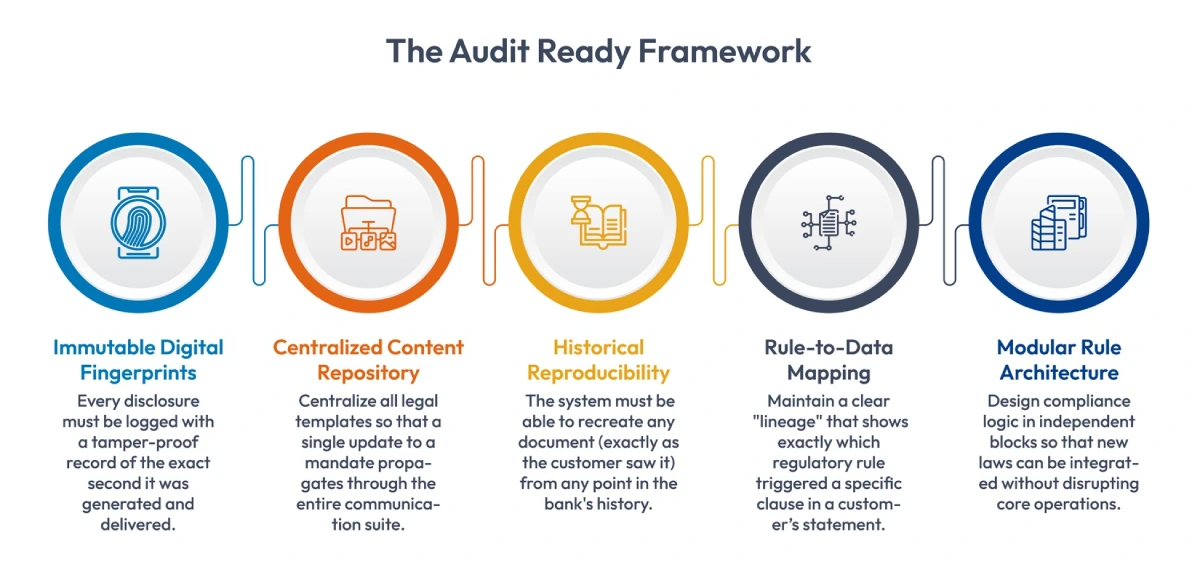
This proactive approach ensures the burden of proof is met before a regulator even makes a request. By utilizing automated regulatory disclosure management to build for future-proofing, the arrival of a new mandate is treated as a routine system update rather than an institutional crisis.
The Business Value of Compliant Innovation
Modern banking views compliance as a barrier, yet the right bank compliance software acts as a catalyst for growth. Robust guardrails reduce friction, allowing institutions to debut products with unprecedented speed.
Rapid Market Entry
Drafting disclosures manually often delays product launches by months. Centralized frameworks utilize pre-approved logic blocks to finalize legal documentation in days.
- Operational Speed: Roll out new features without the typical legal bottleneck.
- Strategic Flexibility: Adapt to market shifts while Automated Regulatory Disclosure Management maintains legal precision.
Unified Experience via Omnichannel Bank Statements
Innovation fails if messaging is fragmented. Implementing omnichannel bank statements guarantees that every touchpoint (from mobile alerts to paper mail) delivers identical, real-time information.
- Reliability: Eliminate the risk of outdated terms appearing on secondary platforms.
- Brand Integrity: Ensure a single, accurate version of the truth across the entire digital ecosystem.
Frictionless Onboarding and Strategic Data
Software-driven workflows transform onboarding from a hurdle into a seamless gateway. Furthermore, the data captured for regulatory mandates provides a window into customer behavior, allowing for more personalized financial services.
- Higher Retention: Approve accounts instantly to prevent applicant abandonment.
- Value Extraction: Repurpose “mandatory” data to drive smarter commercial decisions and foster deeper trust.
Final Thoughts
Banking faces a sharp reality where internal data integrity no longer guarantees regulatory safety. The surge in fines proves that fortresses built around databases are insufficient if customer-facing interactions remain broken. Success requires shifting focus from silent data exercises to the front-end communication reality where the most expensive risks reside.
Deploying bank compliance software bridges this gap by replacing fragmented, manual tasks with deterministic systems. Through automated regulatory disclosure management, mass communications transform from potential liabilities into verifiable records of truth. This precision, when delivered via omnichannel bank statements, ensures that every disclosure (digital or physical) is accurate and timely.
Ultimately, solving the compliance paradox means building a foundation of transparency that turns mandatory notices into a strategic engine for trust.
Secure Your Final Point of Contact
Stop letting fragmented document processes expose your institution to avoidable fines.
Discover how Cincom Eloquence provides the control and visibility needed to turn communication into a compliance stronghold.
Schedule your demo now!
FAQs
1. How does bank compliance software support DORA compliance for banking communications?
It provides the digital resilience required by DORA by ensuring communication systems remain operational during ICT disruptions. This infrastructure guarantees that critical disclosures reach customers without fail.
2. Can automated regulatory disclosure management handle multi-language mandates?
Yes. The system applies pre-approved logic to automatically adjust language and local legal text based on customer residency. This ensures every document is jurisdictionally accurate without requiring manual translation.
3. How do omnichannel bank statements simplify regulatory audits?
They create a single, immutable “golden record” of every interaction across all platforms. During an audit, banks can instantly reconstruct the exact version of a statement as seen by the customer, proving both content integrity and delivery.
4. Is a full legacy core replacement necessary to implement these tools?
No. These solutions act as an orchestration layer that sits on top of existing cores. They extract raw data and apply modern compliance rules to the output, allowing for modernization without the risk of a total system overhaul.
5. How does automation prevent “disclosure fatigue”?
The software uses conditional logic to filter out redundant notices and bundle essential information. This ensures the bank remains fully compliant while ensuring customers receive only relevant, clear, and legally required communications.