Introduction
If you are still treating the move from paper to digital as a technology problem, you are already solving the wrong issue. Most organizations have no shortage of tools, platforms, or ideas for digital delivery. What they lack is the discipline to decide which communications actually deserve to move and which channels are worth supporting.
Paper-based communications worked because there were very few decisions to make. A document was printed and sent the same way to everyone, regardless of customer preference or context. Digital delivery changed that model completely. Each document now comes with multiple channel options, different customer expectations, and different cost and compliance implications. When those decisions are not made explicitly, they are deferred, duplicated, or made inconsistently, which is how digital communication channel prioritization quietly breaks down.
The problem becomes more visible as you try to support an omnichannel customer experience. Customers expect communications to show up in the right place, at the right time, in a format that makes sense to them. When you fail to make clear choices, the result is not innovation. It is inconsistent.
This is not a question of doing more digital. It is a question of making deliberate decisions about what moves, where it moves, and why. The sections that follow lay out a clear way to do exactly that, without pretending every document and every channel deserves equal attention.
The Value of Moving Communications to Digital
Digital communications are valuable because, when applied correctly, they remove friction from how information is delivered, received, and managed.
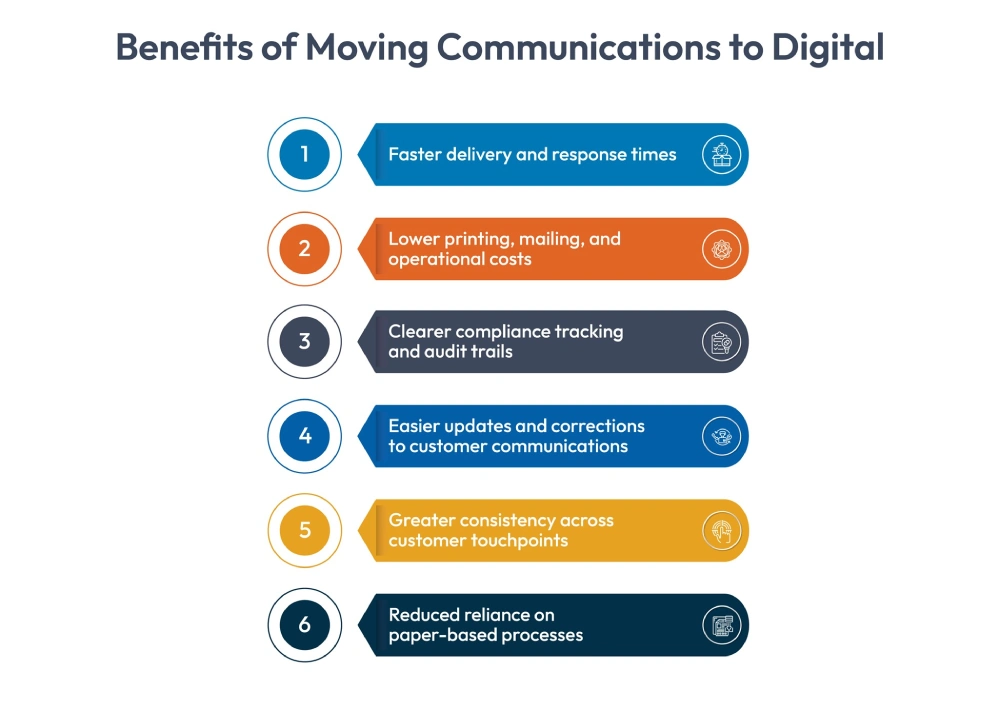
These outcomes do not come from digitizing everything. They come from choosing the right communications and committing to the channels that actually support the customer and the business. Prioritizing CCM channels is the difference between controlled progress and fragmented execution.

A Three-Step Framework for Communication and Channel Prioritization
Step 1: Understand Regulatory Constraints
Before you make any decisions about which communications move to digital or which channels to support, you have to understand the rules. Regulations are not a suggestion. Ignoring them guarantees wasted effort, frustrated customers, and potential fines. Digital communication channel prioritization cannot start on shaky legal ground.
Identify What Is Allowed and What Is Not
Every region, product, and document type carries its own rules. Some communications can freely go digital. Others require printed delivery, signatures, or additional security. You need to know these distinctions before you plan anything. Start by:
- Reviewing national, state, or provincial regulations that govern digital delivery.
- Understanding product-specific requirements, especially for sensitive documents.
- Checking industry standards or contractual obligations that dictate delivery methods.
Document Your Compliance Boundaries
Regulatory knowledge is useless if it stays in someone’s head. Capture it clearly:
- Make a simple reference table or spreadsheet mapping each document type to its allowed channels.
- Highlight communications that are restricted, prohibited, or require additional verification.
- Update it regularly as rules and business offerings change.
Use Compliance as a Filter
Once the rules are clear, you can make real decisions. Digital communication channel prioritization must respect compliance first. That means:
- Any communication not allowed digitally is automatically deprioritized.
- Channels that violate rules should never be tested simply because they look modern.
- Focus resources on communications where regulations permit digital delivery and customer value is highest.
By starting with compliance, you ensure every choice that follows is both defensible and actionable. It eliminates guesswork, prevents wasted effort, and creates a foundation for the next steps in the framework.
Step 2: Understand Customer Preferences
Digital communications fail if your customers do not want or cannot use them. The strongest paper-to-digital migration strategy starts with the people who receive your communications, not the platforms you deploy. Prioritizing channels without understanding customer preferences undermines adoption and erodes trust.
Listen Before You Act
You cannot assume customers will adopt the “latest and greatest” digital options. They have habits, preferences, and expectations shaped by convenience, security, and familiarity. To get it right:
- Conduct surveys or polls to understand preferred delivery channels.
- Track usage data from portals, apps, or email links to see actual behavior.
- Ask customer-facing teams what they hear most often from clients.
Engage Customer-Facing Teams
Frontline staff are the early warning system. They interact with customers daily, notice frustration points, and can reveal patterns that analytics alone might miss. Include them in your planning to:
- Identify communications that require clarification or explanation.
- Highlight documents where digital delivery would add value.
- Capture feedback on timing, format, and channel preferences.
Map Channels to Customer Segments
Not all customers use every channel equally. Segment your audience to match communications to the right medium:
| Customer Segment | Preferred Channel | Document Type | Delivery Considerations |
| Tech-savvy individuals | Email, mobile app | Statements, notifications | Quick access, mobile-friendly formatting |
| Traditional users | Web portal, PDF download | Policies, invoices | Printable copies, secure portal access |
| Multi-location enterprises | Secure portal, email | Reports, contracts | Centralized access, multiple users |
| High-touch clients | Personalized emails, portal | Proposals, account updates | Tailored content, and timing matters |
| Regulatory-sensitive users | Secure portal only | Legal notices, compliance docs | Must meet strict regulatory delivery rules |
| Occasional users | Email summary | General updates, newsletters | Easy to access, minimal clicks required |
Use Insights to Guide Prioritization
Once you know what customers want and expect:
- Align the most-used channels with high-value communications.
- Avoid investing in channels customers ignore.
- Integrate this understanding into the broader paper-to-digital migration strategy.
Customer preferences are not static. They evolve with technology and expectations, so revisit them regularly. A channel that works today may underperform tomorrow. The goal is a deliberate, customer-focused approach that supports both satisfaction and efficiency.
Step 3: Evaluate Effort and Cost Across Channels
Understanding regulations and customer preferences is necessary, but it is not sufficient. The most elegant plans fail if the effort or cost to implement them outweighs the value. Step 3 forces you to confront the practical realities of digital communication: what can be delivered efficiently, what will require heavy lifting, and what is worth the investment in terms of the omni-channel customer experience.
Assess the Effort Required
Each communication channel and document type comes with different implementation requirements:
- Email: Low effort to send once templates are established, but high volume can create monitoring and support overhead.
- Web portal: Moderate effort to integrate and maintain, requires secure access and user authentication.
- Mobile app push: High effort to develop, test, and maintain, and adoption depends on customer engagement.
- Physical mail fallback: Still necessary for certain documents, requires printing, postage, and labor.
Understanding these differences prevents wasted resources on channels that deliver minimal impact.
Analyze Costs vs. Value
Not all digital delivery options are created equal. Costs include software, infrastructure, design, testing, and ongoing support. Value is measured in customer adoption, satisfaction, and compliance assurance. To guide prioritization:
- Rank communications based on frequency, criticality, and regulatory sensitivity.
- Compare the cost of delivery against customer value and engagement metrics.
- Consider whether alternative channels provide a similar impact at a lower cost.
Make Informed Trade-Offs
This is where digital communication channel prioritization becomes actionable. The most advanced or “flashy” channel is not automatically the best. Trade-offs are necessary:
- Choose channels that deliver maximum value without high cost or effort.
- Accept that some documents will remain on lower-cost channels temporarily.
- Align decisions with customer expectations to maintain a consistent omni-channel customer experience.
Document and Review Decisions
Once trade-offs are made, document them clearly. This ensures:
- Consistency across teams and future initiatives.
- Transparency when revisiting priorities.
- Alignment with your overall paper-to-digital migration strategy.
Effort and cost considerations do not make the decision easier; they make it real. Combining these insights with Steps 1 and 2 ensures your organization is making deliberate, defensible, and effective choices. The result is a structured, customer-focused digital strategy that supports both compliance and the omni-channel customer experience.
Bringing It All Together: Making Smart Digital Communication Choices
The three-step framework is designed to guide deliberate, defensible choices. When used together, these steps create clarity about what moves to digital, where it moves, and why, while keeping both customer experience and compliance front and center. This approach forms the foundation of a strong paper-to-digital migration strategy for CCM, ensuring every decision is purposeful and aligned with both operational and customer priorities.
How the Three Steps Work Together
| Step | Focus Area | Key Action | Outcome |
| Step 1: Understand Regulatory Constraints | Compliance | Identify which communications are restricted or prohibited | Ensures all digital moves are legally sound |
| Step 2: Understand Customer Preferences | Customer Experience | Determine preferred channels and content for each segment | Supports omni-channel customer experience and adoption |
| Step 3: Evaluate Effort and Cost Across Channels | Feasibility | Assess effort, cost, and trade-offs for each channel | Guides digital communication channel prioritization for maximum value |
Emphasis on Prioritization Over Wholesale Transformation
Trying to digitize everything at once is a recipe for wasted effort and poor adoption. Prioritization ensures resources go to the communications and channels that deliver the greatest impact. It allows your organization to move deliberately, improve customer experience quickly, and scale the digital transformation sustainably.
Role of Customer Communication Management Software
Customer Communication Management (CCM) software is not just a delivery tool—it is the backbone of a disciplined paper-to-digital migration strategy for CCM. Without a structured system to manage, track, and optimize communications, even the best three-step framework falls apart. CCM software ensures that decisions made in Step 1, Step 2, and Step 3 are implemented consistently, measured accurately, and adjusted over time.
How CCM Software Supports Prioritization
- Centralizes Communication Data: Stores all documents, customer preferences, and delivery rules in one place for easy reference and governance.
- Tracks Delivery and Adoption: Monitors which communications are sent, through which channels, and how customers interact with them.
- Supports Compliance: Ensures that regulatory requirements are embedded in delivery workflows, reducing risk of non-compliance.
- Enables Iterative Improvement: Provides analytics and reporting to refine channel prioritization, update content, and adjust strategies based on real performance.
- Facilitates Omni-Channel Customer Experience: Aligns multiple delivery channels to ensure customers receive communications in the right format, at the right time, and on the channels they prefer.
By leveraging CCM software effectively, organizations turn a set of decisions into repeatable, scalable, and auditable processes, ensuring the paper-to-digital transformation delivers real value, not just activity.
Move Digital Communications Forward with Cincom Eloquence
Cincom Eloquence helps you bring structure and discipline to customer communications. It enables you to prioritize the right communications, support an omni-channel customer experience, and execute a paper-to-digital migration strategy for CCM without losing control or compliance.
FAQs
1. How often should organizations revisit digital communication channel prioritization?
Digital communication channel prioritization should be reviewed regularly as regulations, customer behavior, and channel usage change. Treat it as an ongoing discipline, not a one-time decision.
2. Why is customer adoption critical to a paper-to-digital migration strategy for CCM?
Without customer adoption, digital delivery adds complexity without value. A paper-to-digital migration strategy for CCM must be guided by how customers actually use and respond to communications.
3. How can organizations maintain an omnichannel customer experience over time?
Consistency in content and timing matters more than using every channel. An omni-channel customer experience depends on clear rules for when and how each channel is used.
4. What is a common mistake when prioritizing CCM channels?
Expanding channel options without defining priorities. Prioritizing CCM channels requires discipline, not experimentation for its own sake.
5. Does digital communication channel prioritization help control costs?
Yes. Digital communication channel prioritization reduces redundancy and focuses investment on channels that deliver measurable value.