Introduction
As regulated organizations expanded customer communications into digital channels, the number of messages sent to customers increased sharply, and the effort required to manage them increased even faster. Product changes, regulatory updates, customer-specific variations, and channel requirements began flowing through multiple systems at the same time. Teams continued approving content, but once that content entered production, it passed through handoffs, local edits, and embedded logic that were difficult to track in a consistent way. Over time, organizations lost a clear line of sight into how regulated communications were actually produced and delivered.
This is where the business case for Customer Communication Management (CCM) becomes practical rather than theoretical. In regulated industries, if organizations cannot show how approved content was assembled, modified, and sent across channels, confidence breaks down under audit and regulatory review. CCM technology provides a controlled environment where rules, approvals, and delivery logic remain connected, allowing organizations to manage growth without losing the ability to explain and defend their communications.
The Control Gap That Doesn’t Show Up on Dashboards
Most regulated organizations believe they have visibility into customer communications because reporting exists. Dashboards show volumes, exceptions, and completion rates. What these mechanisms rarely show is how control erodes during normal operations, between formal checkpoints.
The gap forms in predictable places:
Where governance weakens in daily execution
- Approved templates copied into channel tools for speed
- Business rules recreated locally to meet urgent requirements
- Content changes applied to meet one regulation while affecting others
- Logic embedded in systems with limited audit traceability
Each of these actions is routine. None of them triggers alarms. Together, they change how regulated communications behave in production.
What dashboards usually track
- Message volumes by channel
- Completion of review cycles
- Exception counts after the fact
What they rarely capture
- How content was assembled at the time of delivery
- Which rules were applied to which customers
- Whether execution matched the approved design
This gap matters because regulators and auditors do not ask for activity summaries. They ask for evidence. When an organization cannot reliably reconstruct how a specific communication was produced and sent, confidence erodes quickly, regardless of how clean the dashboard apps are.
Why the Control Gap Becomes a Funding Question
The control gap described above rarely triggers immediate action because it does not show up as a failure. Communications go out. Customers respond. Audits are completed. From the outside, the system appears to function. The problem surfaces only when organizations are asked to explain past decisions with precision, often under time pressure and scrutiny.
This is where CCM technology enters the discussion as a business decision rather than a tooling upgrade. The question shifts from operational convenience to risk exposure. Organizations begin to evaluate how much effort, uncertainty, and reputational risk they are willing to carry in order to avoid investing in a controlled communication environment. The business case forms when leadership recognizes that the cost of maintaining the current state is no longer abstract, even if no incident has yet occurred.
Building the Business Case for CCM Technology
The business case for CCM technology in regulated industries starts with accountability. Senior leaders are asked to sign off on communications that affect customers’ financial positions, coverage, rights, and obligations. Over time, as volume and variation increase, that accountability becomes harder to sustain without a system that preserves control from design through delivery.
A credible business case connects operational reality to executive risk. It explains where effort is being absorbed, where assurance depends on manual intervention, and where the organization is exposed simply because communications execution has outgrown the structures that were built to manage it.
What Leaders Are Actually Trying to Control
When executives review investment proposals related to customer communications management software, they are rarely focused on output volume or channel expansion. Their concerns tend to cluster around a narrower set of questions:
- Can the organization explain how specific customer communication was produced, approved, and delivered?
- Can that explanation be repeated consistently across products, regions, and channels?
- Can changes be introduced without increasing regulatory exposure or operational friction?
CCM technology becomes relevant when existing systems cannot answer those questions without extraordinary effort. At that point, the discussion moves beyond efficiency and into assurance.
Where the Current Cost Model Breaks Down
Many organizations underestimate the cost of operating fragmented communication environments because the spending is distributed and partially hidden. Licensing fees are visible. The rest accumulates quietly.
Common cost contributors include:
- Rework caused by inconsistent rules across channel tools.
- Manual reviews added to compensate for weak execution controls.
- Delays in regulatory updates due to template duplication.
- Audit preparation efforts that rely on reconstruction rather than evidence.
- Risk escalation when explanations depend on individual knowledge rather than system traceability.
Individually, these costs appear manageable. Taken together, they represent a structural tax on growth. The business case for CCM software gains traction when these costs are framed as recurring and unavoidable under the current model.
What Changes When CCM Technology Is Introduced
A well-implemented CCM system changes the way you manage risk. Control moves upstream, closer to design, and remains intact as communications are assembled and delivered.
Organizations typically see the following shifts:
- Approved content and logic remain centralized while still supporting variation.
- Execution follows the same rules across channels without reimplementation.
- Evidence is generated as part of normal operations rather than after the fact.
- Business teams operate within defined boundaries instead of relying on manual checks.
These changes matter because they reduce dependence on exception handling. The organization spends less time proving that it did the right thing and more time ensuring that it does.
Framing the Investment Conversation
For regulated industries, the strongest business cases avoid positioning CCM technology as a transformation for its own sake. Instead, they focus on sustainability.
Key framing points that resonate with decision-makers include:
- The ability to scale communications without increasing audit burden.
- Reduced reliance on institutional knowledge to explain past actions.
- Faster response to regulatory change without fragmenting controls.
- Predictable execution across products and customer segments.
At this stage, the question is no longer whether the organization can continue operating as it does today. It is whether continuing to do so is defensible as volume, scrutiny, and complexity increase.
Quantifying the Business Case for CCM Technology
Regulated organizations rarely justify the CCM system through a single ROI number. The business case is built by translating operational friction and control exposure into measurable impact. What matters is not theoretical savings, but where time, effort, and risk accumulate under the current model.
Below is how experienced organizations typically frame the numbers:
| Area of Impact | How It Is Quantified | Why It Matters |
| Regulatory change execution | Time and cost to update all affected communications across channels. | Slow updates increase exposure and create inconsistency. |
| Audit and compliance effort | Hours spent reconstructing evidence for reviews. | Reconstruction signals weak control, even when outcomes are acceptable. |
| Operational rework | Volume of templates, rules, or logic duplicated across systems. | Duplication increases error rates and ongoing maintenance. |
| Exception handling | Number of manual interventions required to correct issues. | Manual fixes scale poorly and hide systemic weaknesses. |
| Release velocity | Time from approved change to customer delivery. | Delays affect customer trust and regulatory commitments. |
Most teams follow a practical approach rather than a perfect one:
- Establish a baseline using recent audits, regulatory changes, and remediation efforts.
- Quantify effort using real project data rather than estimates.
- Model future growth in volume, channels, and regulatory complexity.
- Show how costs rise under the current structure versus a controlled execution model.
The result is not a dramatic savings claim. It is a credible argument that the current approach does not scale without increasing risk and operational drag.
Evaluating CCM Technology Vendors in Regulated Environments
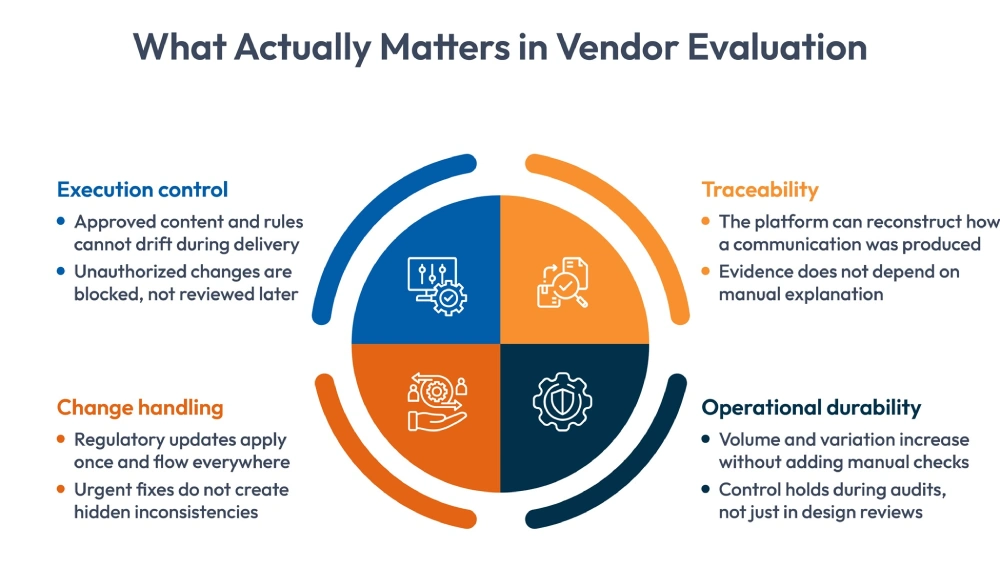
Vendor evaluation is where the business case either holds or quietly collapses. In regulated industries, CCM software is often compared on features and channel support, even though the real risk sits in execution. What matters is whether approved content, rules, and logic remain intact once communications move into production and change begins.
For a deeper examination of CCM vendor evaluation criteria and real-world tradeoffs, refer to our detailed analysis here.
Conclusion
The business case for CCM technology in regulated industries centers on control, traceability, and defensibility. As communication volumes grow across products, customers, and channels, organizations must be able to show how regulated content was governed, assembled, and delivered in real operating conditions. That requirement exists regardless of channel mix, delivery speed, or organizational structure.
The CCM system establishes a single operational framework where rules, approvals, data logic, and delivery remain connected. This allows regulated organizations to support scale while maintaining evidence that stands up to audit and regulatory review. When communications can be explained with precision and consistency, confidence follows. That confidence enables growth, change, and operational stability without introducing exposure that the business cannot account for.

See how Cincom Eloquence brings governed, traceable customer communications under one controlled system
FAQs
1. How do regulated organizations determine whether communication risk is systemic or isolated?
They examine whether issues can be traced back to a single governed source or whether reconstruction requires piecing together decisions across systems, teams, and timelines.
2. What signals indicate that communication governance has fallen behind operational reality?
Frequent “one-off” fixes, parallel templates, and localized rule changes that cannot be reconciled during review cycles.
3. How does CCM change the way accountability is established during audits?
It shifts accountability from individual teams and tools to a documented chain of approved content, rules, and execution logic.
4. Why do point solutions fail to scale under regulatory pressure?
Because controls applied at the channel or team level cannot preserve intent once communications are reused, adapted, or automated.
5. What should executives expect to see once communication control is properly established?
Fewer escalations during audits, faster response to regulatory updates, and the ability to explain outcomes without relying on institutional memory.