For many insurers, the approach toward IT budget construction and the measurement of IT value remains rooted in a traditional approach of centrally planned budgets and top-down portfolio metrics that can mask where IT value is really being delivered.
Those who are looking to better understand how value is being delivered for IT should not only look toward the building blocks that make up their IT cost base; they should also consider ways to translate them into an outcome-based measure of IT value. IT organizations that are seen as more strategic are more likely to measure the overall financial impact of technology delivered.
This shift sits at the core of CCM modernization to IT management, where technology investments are expected to deliver clear, measurable business outcomes.
Evaluating CCM Modernization: Key Criteria for IT Management
When it comes to CCM Modernization to IT Management, evaluating a new Customer Communications Management (CCM) application becomes highly important. IT management should consider three key areas:
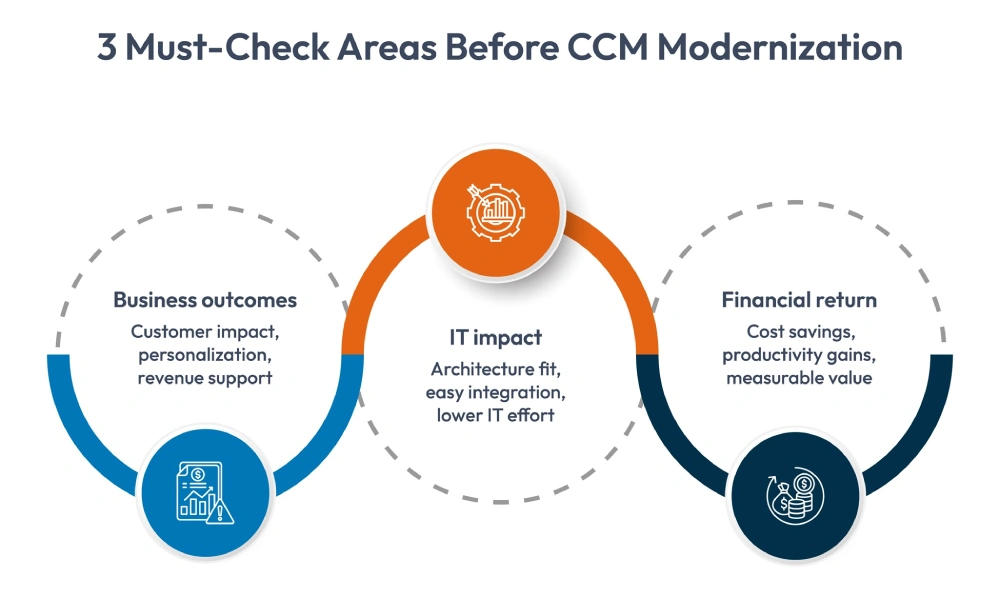
- support of key business outcomes
- the impact on IT
- the level of financial return
These criteria help IT leaders move beyond cost-based evaluation and toward translating IT value into business outcomes.
Support of Key Business Outcomes
Customer communication solutions can have a significant impact on key business outcomes. Linkages between the outcomes and the application should be as detailed and explicit as possible. It is fine to say that a proposed customer communication application investment will improve the customer or agent experience; that may be true and an important justification.
However, it is much better to identify specific elements of the customer experience and translate those into business impact. For example, it may be that representatives are able to quickly personalize letters to customers for cross-sell or upsell campaigns, and the e-delivery of those letters will save quantifiable dollars on paper, postage and labor.
In addition, the ability to personalize and execute more campaigns should result in increased sales.
By modernizing legacy CCM systems, insurers can move from static, manual communications to more dynamic, targeted interactions that directly support revenue growth and retention.

Build a Compelling Financial Business Case for Modernizing Customer Communications Systems
Impact on IT
For any new customer communications project, IT management must understand the impact on IT in three areas: fit to the current architecture, integration effort, and the IT resources required to support development and production. The IT architecture evaluation is important since it has direct implications for the integration effort and resources and ultimately translates into time and money.
New customer communication solutions should fit well into the current architecture and the current software products that inhabit that architecture. But integration is often the top issue when implementing new applications.
In an ideal situation, the new customer communications application will be based on a modern, web services architecture with well-defined interfaces for integration. Prior integrations with related core systems and the experience of the vendor in working with other key suppliers are vital.
Finally, IT management will determine how the new application will affect their valuable resources. In the case of customer communication solutions, the impact extends beyond system implementation into support in the production environment.
Platforms that are designed to support reducing IT resources for customer communications over time allow IT teams to focus on higher-value initiatives rather than ongoing maintenance and rework.
Business-User Friendly CCM for IT Efficiency and Long-Term Flexibility
Solutions that are “business-user friendly” and allow the user to make modifications without (or with minimal) IT involvement are a win-win. The business user gets up to speed quickly and has the flexibility to address their objectives, and IT spends less time training and making changes to the system over time.
Financial Return
The return on investment will be a critical component of any plan that IT management develops and/or considers. Elements of the financial case will be included from the analysis of business outcomes and the impact on IT as described above.
Generally, the business case for a new customer communications application will hinge on improved productivity for users; cost savings from reduced paper, postage and IT resources; and improved compliance. Overall, there are many elements that will factor into financial return.
In addition to the efficiency and cost-related factors, there are important upside levers that relate to the business objectives of the users, such as the impact on sales, retention, or claims.
In many cases, the potential to affect the key business outcomes will drive the justification for IT management as they seek to respond to their colleagues on the business side.
Supporting CCM Modernization to IT Management with Cincom Eloquence
For insurers evaluating CCM modernization initiatives, Cincom Eloquence proves to be a robust CCM solution that aligns well with the IT management priorities outlined above.
Cincom Eloquence helps insurers modernize legacy CCM systems, reduce ongoing IT effort, and enable business users to manage communications with minimal IT involvement—all while maintaining control, compliance, and consistency.
This makes Cincom Eloquence a strong fit for organizations looking to connect CCM modernization directly to IT efficiency and business outcomes.
How Strong is Your Insurance Customer Communications Strategy? Evaluate Now!
CCM Modernization as a Measure of IT Performance
As insurers continue to modernize legacy CCM systems and rapidly deploy new technologies, the measurements of IT value will continue to mature and shift toward value metrics (those who are looking at the outcomes of cost, time and value improvements) to rate the performance of IT.
Customer communication is a key area where all of these outcomes can be achieved, and quickly. By investing in CCM modernization that supports business outcomes, reduces IT complexity, and delivers measurable financial returns, IT management can clearly demonstrate its strategic value to the organization.
In this context, CCM modernization to IT management becomes not just a technology upgrade, but a practical way to translate IT value into tangible business results.
FAQs
1. What is Customer Communications Management (CCM)?
Customer Communications Management (CCM) refers to the systems and processes used to create, manage, and deliver customer communications such as policy documents, statements, letters, and digital messages across print and electronic channels.
2. How does CCM help insurers improve customer communications?
CCM helps insurers deliver accurate, consistent, and timely communications. It enables personalization, supports multiple delivery channels, and ensures messages align with regulatory and brand requirements.
3. What does CCM modernization mean for IT management?
CCM modernization involves upgrading legacy communication systems, so IT can reduce complexity, improve efficiency, and clearly link technology investments to measurable business outcomes.
4. How does CCM modernization reduce IT resources for customer communications?
By simplifying integrations and enabling business users to manage templates and content, modern CCM platforms reduce ongoing IT involvement in routine changes and support.
5. Why is integration important when selecting a CCM solution?
Integration impacts implementation speed, cost, and long-term sustainability. CCM solutions with modern architectures and proven integrations fit more easily into existing IT environments.
6. How does Cincom Eloquence support CCM modernization for insurers?
Cincom Eloquence supports CCM modernization by fitting into existing IT architectures, reducing IT effort over time, and enabling business users to manage communications while ensuring consistency and compliance.