Introduction: Why Customer Communications Deserve a Dedicated Strategy
Customer communications are often treated as an extension of core systems. They are generated where the data lives, assembled where it is convenient, and rarely questioned unless something goes wrong. Over time, this becomes the default strategy, even though no deliberate choice was made.
This is where the conversation around “CCM Best-in-Breed vs All-in-One” begins.
An all-in-one approach assumes that communication is simply another function that can be absorbed into a larger platform. A best-in-breed CCM approach starts from a different premise. It treats customer communication as its own discipline, with its own logic, risks, and lifecycle.
The distinction matters because customer communications are not neutral. They carry legal meaning, reflect data-handling practices, and shape how customers interpret decisions made by an organization. Choosing a dedicated approach for customer communications is not about adding more technology. It is about deciding where control, accountability, and flexibility should sit. That decision, once made, tends to shape customer experience and operational risk far longer than most organizations initially expect.
The Core Decision: Generic Communication Capability or Purpose-Built CCM
Organizations evaluating a communication approach should pause and ask a few uncomfortable questions:
- Can a generic communication capability keep up with regulatory change without forcing core system modifications?
- Can it support personalization at scale without increasing operational risk?
- Can it evolve as customer expectations shift, without inflating the total cost of ownership over time?
A centralized, all-in-one platform may seem simpler because everything is consolidated in one system. In reality, centralization often comes with tighter coupling—communication logic is embedded deeply into core systems, which can slow down changes and complicate governance.
A purpose-built CCM approach takes a different path. It treats communication as a distinct, controlled layer that integrates with core systems without being constrained by them. This allows for a deliberate CCM solution integration strategy, where data flows intentionally instead of being absorbed indiscriminately into a centralized platform.
The choice is not about features. It’s about whether customer communications need the flexibility to evolve continuously or simply keep pace with existing processes.

4 Key Strategies for Achieving Consistent Customer Communications and Impactful Interactions
Best-in-Breed CCM vs. All-in-One Communication Platforms
| Dimension | All-in-One (Generic Communication) | Best-in-Breed CCM (Purpose-Built) |
| Role of CCM | Supporting feature inside a broader platform | Dedicated system for customer communications |
| Design focus | Platform breadth and consolidation | Communication depth and control |
| Change agility | Tied to core system release cycles | Changes managed independently at the CCM layer |
| Personalization | Basic, template-driven | Data-driven personalization at scale |
| Compliance handling | Reactive and process-heavy | Built-in governance and auditability |
| Data privacy control | Platform-wide, coarse-grained | Fine-grained control over data usage in communications |
| Integration model | Data absorbed into the platform | Intentional integration via APIs |
| Operational risk | High coupling, wider blast radius | Isolated changes, reduced risk |
| Total Cost of Ownership | Lower upfront, increases with change | Predictable and lower long-term TCO |
| Long-term suitability | Stable, low-change environments | Continuous change and evolving expectations |
Why Best-in-Breed CCM Is the Strategic Choice
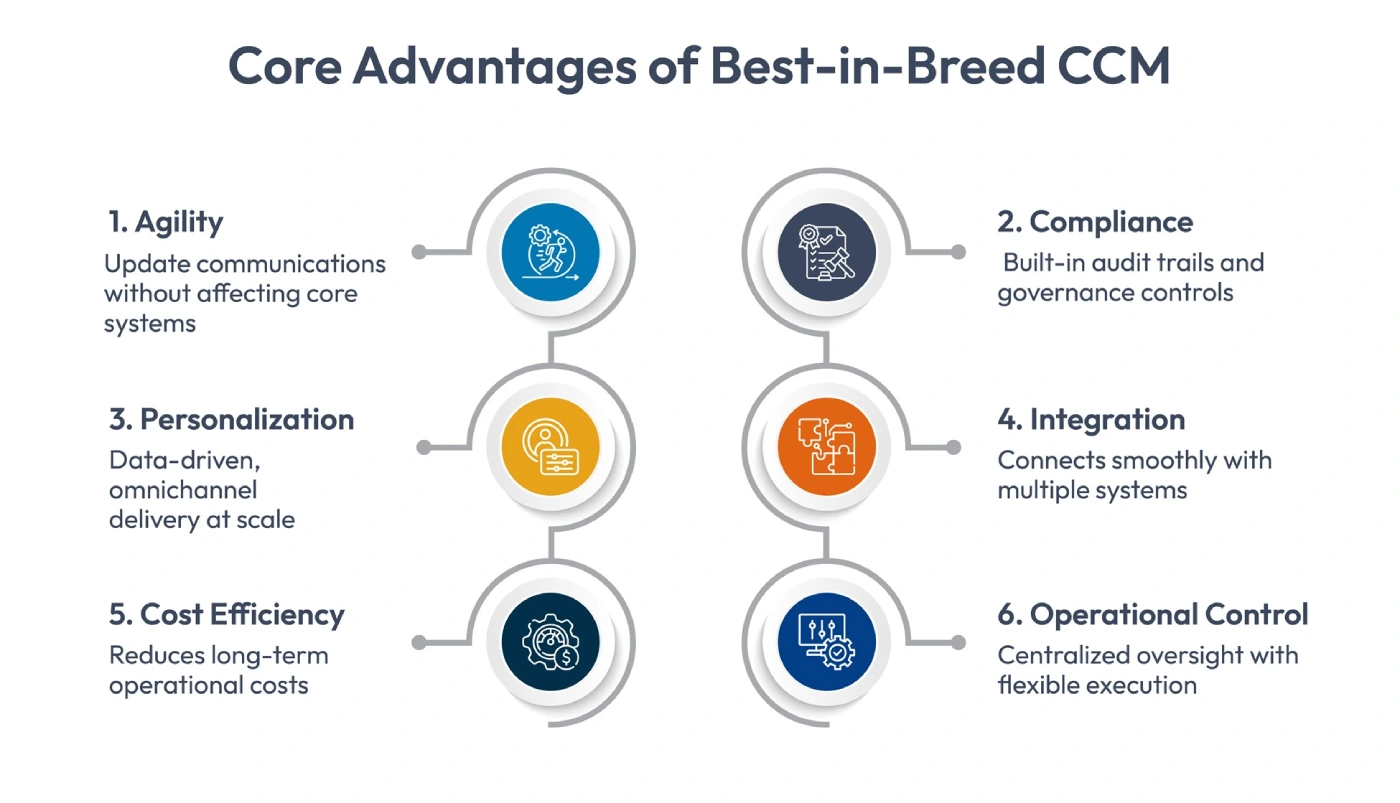
A Best-in-Breed platform doesn’t just offer functionality; it enables organizations to unlock CCM integration benefits through a true centralized customer communication platform and a carefully planned CCM solution integration strategy that connects systems, data, and channels without compromise.
Adopting a best-in-breed CCM approach ensures organizations fully realize integration benefits. and can operate efficiently while staying compliant and responsive. It provides the control, adaptability, and visibility needed to manage communications confidently today and scale effectively for the future.
How to Choose the Right CCM Software
Now that we understand why a best-in-breed approach is significant for customer communications, the next step is figuring out how to select the right platform. Choosing software is more than picking a tool; it’s about finding a system that supports your operations, compliance needs, and evolving customer expectations for years to come. Here are some key criteria to guide your evaluation:
1. Alignment with Business Needs
The software should match the complexity and volume of your communications. Evaluate whether it can handle your workflows, templates, and delivery channels efficiently. Ask yourself:
- Does it support the types of communications we need today and in the future?
- Can it adapt if new channels or rules are introduced?
2. Integration Capabilities
A strong platform should integrate seamlessly with existing systems without creating dependencies that slow down updates. Consider whether it can act as a centralized customer communication platform where communications are controlled and orchestrated while remaining connected to core systems. Reflective questions:
- How easily can it pull data from multiple sources?
- Does it offer APIs or connectors for future system upgrades?
3. Compliance and Governance
The platform must help enforce regulatory compliance and provide auditability. This includes tracking who created what, when, and why, as well as version control and approval workflows. Questions to consider:
- Does it provide automated checks for regulatory requirements?
- Can we generate audit reports easily?
4. Usability and Flexibility
Even the most powerful system fails if your team cannot use it effectively. Look for intuitive design, drag-and-drop composition, and flexible templates. Ask yourself:
- Can business users configure communications without IT intervention?
- How quickly can the team implement changes when needed?
5. Scalability and Performance
The platform should handle growing volumes and increasingly complex communication logic.
- Can it scale across multiple regions or business units?
- Will performance remain reliable as communications increase?
6. Security and Data Privacy
Customer communications often contain sensitive data, so security is critical.
- Does it comply with relevant data privacy regulations both in terms on state and cross-border?
- Are there granular controls for data access and usage?
7. Analytics and Insights
A platform should provide actionable insights to improve communication effectiveness.
- Can it measure delivery, engagement, and response rates?
- Does it help identify areas for process optimization or personalization?
8. Total Cost of Ownership
Look beyond initial licensing fees. Evaluate long-term operational costs, including maintenance, integration, and upgrades.
- Will costs grow disproportionately as business needs evolve?
- Does it offer predictable budgeting over time?
9. Vendor Support and Roadmap
The right vendor can make or break implementation and long-term success. Consider their support model, responsiveness, and vision for the product. Reflective questions:
- Does the vendor provide training, onboarding, and ongoing support?
- Is the product roadmap aligned with emerging trends in customer communications?
The 2026 Vision: Why Customer Communications Must Evolve
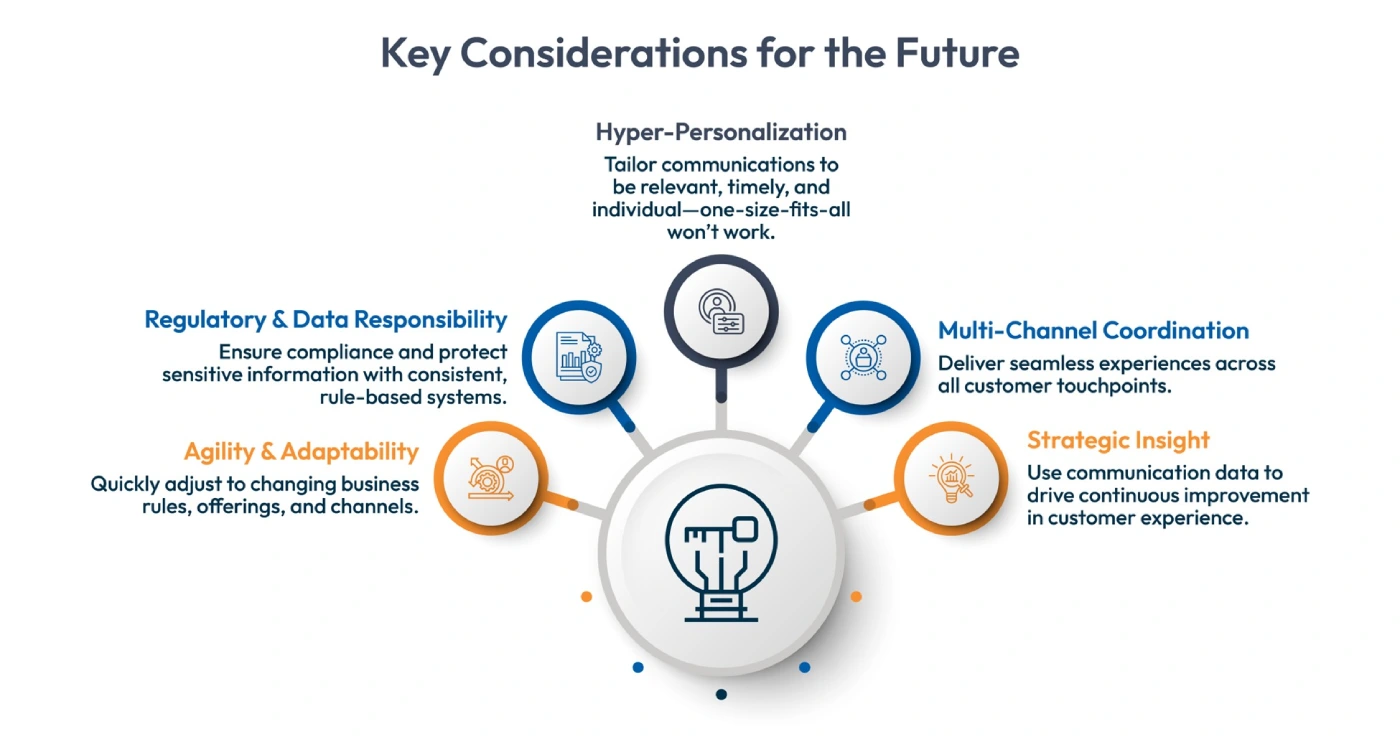
Time is moving fast, and customer expectations are evolving faster than most organizations anticipate. In 2026, the role of customer communications will no longer be limited to delivering information; it will be about curated, specialized, and highly contextual interactions that drive trust, clarity, and compliance.
Generic or all-in-one solutions are unlikely to keep pace with these demands. To stay ahead, organizations must embrace a purpose-built CCM approach that allows communications to be curated, specialized, and fully controlled, while remaining agile, compliant, and future-ready.
Final Words
We started this article around the conversation of “CCM Best-in-Breed vs All-in-One”, exploring why this decision matters far beyond features and checkboxes. As we’ve seen, customer communications are strategic; they influence compliance, operational control, and how customers experience an organization.
Choosing a Best-in-Breed CCM solution gives organizations the flexibility, control, and adaptability needed to manage communications that are curated, specialized, and future-ready. It is not just about handling messages efficiently today; it is about building a foundation that can evolve as regulations, customer expectations, and business needs change.
Ultimately, the right approach enables teams to deliver communications with precision, confidence, and lasting impact—ensuring that every interaction reflects the organization’s standards, values, and strategic priorities.
Discover how Cincom Eloquence can help you deliver curated, compliant, and personalized communications with agility and confidence.
FAQs
1. How does a best-in-breed CCM approach support an integration strategy?
A Best-in-Breed CCM platform allows organizations to integrate communications intentionally across multiple systems and channels, supporting a deliberate CCM solution integration strategy that reduces risk and improves operational efficiency.
2. Does selecting a best-in-breed CCM platform affect total cost of ownership?
Yes. While initial investment may be higher than an all-in-one solution, a best-in-breed approach often lowers long-term costs by minimizing rework, simplifying compliance, and reducing operational overhead, positively impacting total cost of ownership.
3. What are the key CCM integration benefits of using a purpose-built platform?
Purpose-built CCM solutions enable seamless data integration, consistent governance, and multi-channel orchestration, delivering tangible integration benefits such as faster updates, better personalization, and reliable auditability.
4. How should organizations evaluate CCM vendor selection criteria?
Organizations should look beyond features and assess scalability, compliance support, integration capabilities, usability, and long-term roadmap. Applying structured CCM vendor selection criteria ensures the selected solution aligns with both operational and strategic goals.
5. Can a Centralized Customer Communication Platform improve operational control?
Absolutely. A centralized approach allows teams to manage, audit, and optimize communications from one platform while still maintaining flexibility, visibility, and governance across all channels, enhancing efficiency and compliance.