Manufacturers spend a lot of time tracking revenue leaks in their sales process. These leaks are mostly what they can see: late shipments, warranty claims, scrap rates on the shop floor, and returns. Slow quoting rarely makes this list of revenue leaks in manufacturing.
The problem is that most manufacturers still see slow quoting as friction and not a reason for revenue loss. A late quote never gets logged anywhere as lost revenue. Part of the problem is that every individual delay looks reasonable. Engineering needs to confirm viability. A pricing exception needs a sign-off from upper management.
Together, they slow the sales cycle enough to cost deals and compress margin, often without anyone connecting the dots back to the quoting process itself. This article helps you identify how slow quoting leads to revenue leaks in manufacturing and how you can overcome the challenge.
How Slow Quotes Lead to Revenue Leaks in Manufacturing
The damage that slow quoting cycles cause shows up in win rates, margins, and pipeline capacity of the manufacturing enterprise. Here is how slow quotes ultimately lead to revenue leaks in manufacturing:
Lost deals to faster competitors: Customers request quotes from several manufacturers at once. Industry research shows manufacturers who reply first win noticeably more often, even without the lowest price, because speed signals execution capability the buyer can trust once an order is placed.
Compressed sales pipeline: When quotes take days instead of hours, sales reps spend disproportionate time checking with engineering, confirming exceptions, and following up on approvals. Due to this, the sales pipeline slows down too, extending the impact on the entire revenue cycle.
Shaking buyer’s confidence: Buyers evaluating multiple quotes tend to assume that a manufacturer slow to send a quote may also be slow to deliver the final product.

Key Reasons for Slow Quoting
Slow quotes are rarely caused by one obvious failure. They’re usually the result of several smaller structural gaps present in traditional quoting methods.
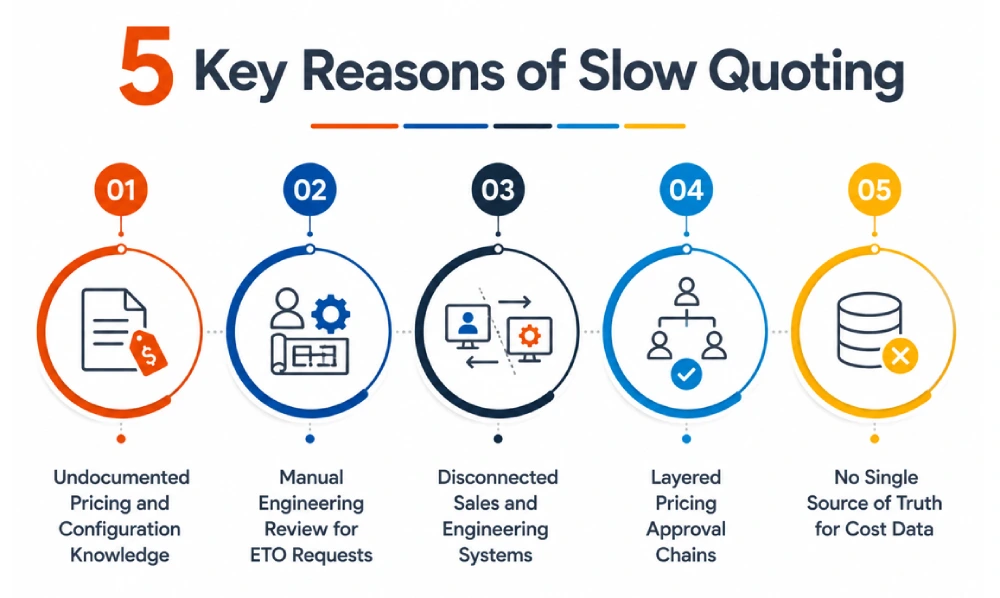
Undocumented Pricing and Configuration Knowledge
Many manufacturers still depend on informal knowledge to price complex products. Discount thresholds, margins, and configuration exceptions often exist only in the memory of a few experienced reps or engineers. When that person is not available, quoting slows immediately, and no one else can confidently confirm the details.
Manual Engineering Review for ETO Requests
In engineer-to-order manufacturing, most requests fall outside standard catalog options. Spreadsheets can’t confirm whether a modified assembly will clear tolerance or whether a substituted material changes cost, so nearly every custom configuration gets routed to engineering. This creates a queue where routine requests wait behind genuinely complex ones, regardless of urgency.
Disconnected Sales and Engineering Systems
When configuration data, pricing, and engineering specs live in separate systems, keeping the mBOM and eBOM aligned as a quote changes depends on manual emails between departments. Any mismatch has to be caught and corrected by hand, which adds delay and creates room for the kind of error that quietly erodes margin later on.
Layered Pricing Approval Chains
Discounts or pricing exceptions beyond a standard threshold typically require sign-off from a manager, and sometimes a second or third approver above that. Each handoff adds waiting time that has nothing to do with the actual complexity of the deal, and quotes can sit for days simply waiting for someone’s attention.
No Single Source of Truth for Cost Data
Reps working from separate spreadsheets and pricing sheets have no reliable way to confirm that they are quoting updated costs. Material prices shift, catalogs get updated, and without one connected system, someone has to manually verify the numbers still match reality, which takes time and invites the exact mistakes that pricing guardrails are meant to catch.
Traditional Quoting Vs Cincom CPQ
Traditional quoting tools configure a product and calculate a price from whatever details a rep enters, but a product configurator validates configuration and pricing at the point of selection. Here is how industrial sales quoting software like Cincom CPQ can help in accelerating B2B manufacturing sales cycles when compared to traditional quoting:
| Area | Traditional Quoting | Cincom CPQ |
| Configuration validation | Configurations have to validated by engineering every time there is a change | Configurations are checked at the point of selection. Invalid configurations are eliminated automatically |
| Engineering involvement | Most non-standard requests are routed to engineering for manual review | Engineering time is reserved for genuine exceptions outside established rules |
| Pricing and margin control | Reps apply discounts from memory or habit, with limited real-time oversight | Enforces pricing and margin thresholds automatically based on the configuration |
| Data consistency | mBOM and eBOM alignment depends on emails between departments | Configuration, pricing, and engineering data stay synchronized in one system |
| Turnaround time | Quotes for custom configurations can take one to two weeks | Valid, priced quotes can go out the same day |
How Cincom CPQ Stops Revenue Leaks in Manufacturing Sales
Cincom CPQ is one of the modern manufacturing CPQ software solutions that help eliminate revenue leaks for enterprises.
- Cincom CPQ helps manufacturers respond on the same day rather than in one to two weeks before a competitor closes the gap.
- Automatic pricing guardrails in Cincom CPQ catch underpriced or overpriced configurations before they go out, instead of relying on a rep to remember every rule.
- Cincom CPQ automates configuration validation and pricing, so engineers are freed from routine configuration checks.
- Cincom CPQ helps manufacturers validate configurations upfront to reduce the rework cycles that extend sales timelines and frustrate buyers.
- Cincom’s rules-based system handles a growing volume of custom quotes without requiring a proportional increase in sales or engineering staff.
Conclusion
Every stalled configuration, manual engineering check, and pricing exception waiting on an approver, is a sign of slow quoting and a reason for revenue leaks in manufacturing. The solution is not asking reps and engineers to work faster inside a broken process. It’s replacing the process itself with one built for the complexity manufacturers are actually quoting today. That means configuration rules that validate buildability instantly, pricing guardrails that protect margin without a manual check, and a single system that keeps sales and engineering working from the same data instead of chasing each other through email.
Cincom CPQ is built to close exactly that gap for engineer-to-order and configure-to-order manufacturers, turning quoting from a bottleneck into a competitive advantage. Explore Cincom Quoting Software: CPQ for Accurate & Fast Quotes to see how the rules engine and pricing guardrails work for your product complexity or request a demo to see your own quotes move from days to hours.
FAQs
1. How to stop revenue leaks in manufacturing sales?
Replace manual, spreadsheet-based quoting with a CPQ system that validates configurations automatically, enforces pricing and margin rules at the point of quote, and keeps sales and engineering data synchronized, so slow, error-prone quotes stop costing deals and margin.
2. How do slow quoting cycles cause hidden revenue leaks in manufacturing sales?
Slow quotes lose deals to faster-responding competitors, compress the sales pipeline as reps chase internal approvals, and shake buyer confidence in on-time delivery. These effects rarely register as a single loss, which is why revenue leaks in manufacturing tied to quoting remain untracked.
3. What is the difference between an enterprise manufacturing CPQ and basic quoting tools?
Basic quoting tools calculate price from manual inputs without confirming buildability. Enterprise manufacturing CPQ software solutions validate configurations at the point of selection, enforce pricing and margin rules automatically, and keep engineering data synchronized with the sales quote.
4. How can industrial equipment manufacturers reduce sales turnaround times for custom configurations?
Industrial sales quoting software that validates configurations automatically removes the need to route every custom request through manual engineering review, reserving engineering time for genuine exceptions and letting valid quotes go out the same day.
5. How does a CPQ rules engine eliminate manual engineering reviews on complex quotes?
By checking compatibility, tolerances, and material rules at the point of configuration, a CPQ rules engine automatically eliminates invalid options before pricing is generated, so engineers are only pulled in for requests that genuinely fall outside established rules.