Introduction
Life insurance and annuity carriers that issue tens of thousands of new contracts a year may find that their Customer Communication Management (CCM) bill climbs at the same pace as their sales, because volume-based pricing attaches a fee to every document a policy generates. The volume-based CCM pricing drawbacks can be easy to miss during procurement, and they can surface later as a slow erosion of margin on each contract the carrier worked hard to win. Communication costs should not rise with the number of policies written, since underwriting, billing, and claims all depend on personalized correspondence that cannot be trimmed without hurting the policyholder. This article explains how volume-based CCM pricing works, what it does to budgets and customer engagement, and how a pricing model that ignores volume changes the economics of growth. It closes with a checklist of questions to ask in any CCM evaluation.
How Volume-Based CCM Pricing Works
In life and annuity customer communication management, a volume-based contract ties the fee to how much the carrier sends out, whatever those documents are worth to the policyholder. Among the CCM pricing models insurance carriers can choose from, volume is usually metered in one of a few ways:
- Per document generated
- Per page rendered or printed
- Per transaction or API call
- By volume tier, with a set band of outputs for each contract year
Tiers can lower the unit rate as output grows, but the total bill still rises with each additional policy, and crossing a contracted limit may add further charges.
To see how this adds up, consider a hypothetical carrier whose contract charges per document. Say one new life policy generates six documents: an illustration, three requirement letters, an underwriting decision letter, and a policy delivery package. At 30,000 new policies a year, that comes to 180,000 billable documents before a single billing notice or claim letter has gone out. If sales grow by a third to 40,000 policies, the count rises to 240,000, and the software bill rises by the same third, although the carrier ran the same underwriting and issuance process it ran the year before.
The illusion of low entry costs
A volume-based contract can look inexpensive at the proposal stage. While the carrier has only one product line on the platform or is still in its first months of deployment, the document count is small, and so is the invoice. If the quote was priced against those early months, it says little about what the contract costs at full issuance volume.
Where it lands in the tech budget
If your technology budget is set annually, a strong sales year can push output past what finance planned for. The CCM line overruns, and the gap has to come from another IT project, a mid-year budget request, or the margin on the business written.
Operational Cost of Volume-Based CCM Pricing for Life and Annuity Carriers
In life and annuity customer communication management, the CCM pricing models shape decisions well beyond the invoice. Volume-based contracts tie cost to output, and that affects three areas of the business.
1. Financial Friction & Budget Volatility
For a CFO or an IT leader at a life or annuity carrier, the CCM line can be hard to forecast because output does not arrive evenly through the year. Annual statement cycles and January 1099-R mailings for annuity owners produce one surge every twelve months. A marketing campaign or a new fixed index annuity launch adds another, and a sudden jump in annuity sales after an interest rate move can add a third. Under per-document or per-page metering, each surge reaches the invoice in full, so a budget set in January may be overspent by the third quarter.
2. Artificially Restrained Customer Engagement
When every output carries a fee, the business team proposing a personalized touchpoint may have to justify its cost each time. Anniversary reviews, mid-term check-ins, beneficiary confirmation requests, and educational mailings for annuity owners approaching the income phase are the most exposed, since none of them is tied to a regulatory deadline. Some will be postponed, and others may never be proposed.
The pressure reaches underwriting and claims as well. If your underwriters are working a case that arrived NIGO (not in good order), it may need several rounds of requirement letters for medical evidence or financial documents, and each follow-up to the applicant or the agent is another billable output. A team watching the meter might space those reminders further apart, which leaves cases open longer and gives applicants more time to abandon the application. In claims, acknowledgments, requests for supporting documents, and status updates rise with claim volume, and a claims team asked to hold down output may send fewer updates to a beneficiary who is already waiting on news during a difficult period. Timelines set under state claims handling rules still apply, so any cutback would fall on the updates a carrier chooses to send.
Carriers may respond by limiting communication frequency to keep the CCM bill down. That could weaken persistency, because these touchpoints exist to keep policyholders informed and policies in force.
3. Modernization & Automation Bottlenecks
If your roadmap includes on-demand policy documents or more digital delivery, each new channel adds outputs to the meter. A self-service portal where policyholders download a values statement whenever they choose can become a budget question before it becomes a project, which is why insurance document generation cost optimization belongs in the platform decision from the start.
Enterprise CCM for Life Insurance: What Predictable Pricing Makes Possible
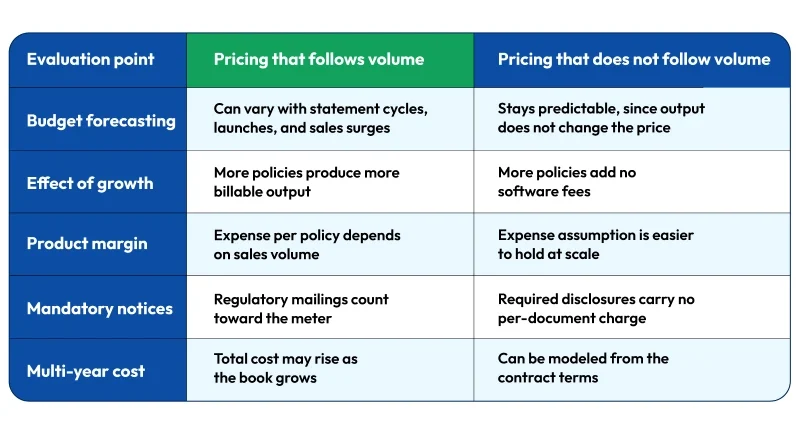
The volume-based CCM pricing drawbacks covered so far share one root: a carrier cannot know in advance what its communications will cost because the bill depends on output the business does not fully control. A pricing model that doesn’t follow volume closes that gap by making software costs predictable, and that predictability changes several decisions a life and annuity carrier makes every year.
Predictability in the Technology Budget
Return to the hypothetical carrier whose sales grew from 30,000 to 40,000 policies. When output carries no price, the extra 60,000 documents add nothing to the software line. If you’re a finance leader setting the technology budget a year ahead, the CCM figure agreed in January is the figure paid in December, whatever happens in statement season, a product launch, or a sales surge. There is no variance to explain in the third quarter, no mid-year request for more funds, and no other IT project asked to give up money to cover the difference.
Predictability in Product Pricing and Margin
If your product and actuarial teams price a new term life or fixed index annuity, they load an expense assumption for each policy issued, and communication cost is part of it. Under metered pricing, that assumption depends on a sales forecast, so a strong launch can raise the true cost above the approved figure. With a predictable software cost, the expense forecast made at product approval is far more likely to hold at full issuance volume, and the margin built into the product holds with it.
Predictability in Communication Decisions
When each output has no price, a proposal for an anniversary review or a beneficiary confirmation request is judged on its value to the policyholder. Insurance document generation cost optimization then moves to the work that improves results: reusing templates and content across underwriting, claims, and billing, keeping output accurate, and cutting the errors that force reissued documents. Mandatory notices and disclosures go out as required, with no cost check before each mailing.
Predictability Across Contract Years
Procurement can model a multi-year cost from the contract terms, and the model does not depend on a sales forecast that may prove wrong.
Questions to Ask Before You Sign: A CCM Evaluation Checklist for Life and Annuity Carriers
A CCM proposal is priced against the volume the vendor assumed when it wrote the quote, and that assumption may differ from the volume your book reaches in year three or in a year when sales double. The questions below test a contract against those later years. Bring them to every vendor conversation and ask for the answers in writing, since a proposal can change after the meeting while signed terms hold.
The Pricing Metric and Its Limits
- Which unit sets the price: documents, pages, transactions, users, or something else, and where is that unit defined in the contract?
- Is there an overage or true-up fee if output passes the contracted level, and how is it calculated?
- If output doubles in a single year, what would the invoice show? Ask the vendor for a figure and not a description.
- Does the rate change between volume tiers, and what happens at the boundary between them?
What Counts as Billable
A contract that meters by document can count more than the letters your policyholders receive. Ask whether each of the following counts toward the meter:
- Regulatory notices and mandatory disclosures
- Corrected or reissued documents
- Test and preview outputs produced while templates are being built
- Each delivery channel, such as print, email, and portal
Each “yes” adds to the invoice without adding a single new policyholder communication, so the answers shape the bill as much as the headline rate does.
Stress-Test the Contract with Your Own Scenarios
Give the vendor your own figures and ask for the annual software cost in each of three situations:
- Your current year, at today’s volume of new business and policies in force.
- A year in which new business grows by a third.
- A year with a new fixed index annuity launch and a heavy claims quarter in the same twelve months.
The gap between the first and third answers tells you how much of your budget depends on your sales forecast.
Life and Annuity Volume Triggers
Some of your largest output days are set by the calendar and by regulators, and the vendor’s sample volumes may not include them. Ask how the contract treats annual statement season and year-end tax forms for annuity owners. Ask what happens if a rule change requires a notice to be sent to every policyholder in force, since one mailing to the whole block can equal the output of several ordinary months. Ask the same about a product filing that requires updated disclosures, because those documents follow the regulator’s timeline and not yours.
Cost Over Time and Outside the License
Ask for a multi-year cost model at your current volume and again at double it. Then find out which terms limit price changes at renewal and whether the vendor can reprice the contract once your output passes a certain level. Ask which costs sit outside the license, such as implementation, template changes, support, additional environments, and new delivery channels, so that the total you compare between vendors is the total you would pay. Ask how you would export your templates and data if you ever leave, since a contract that is expensive to exit reduces your bargaining power at every renewal.
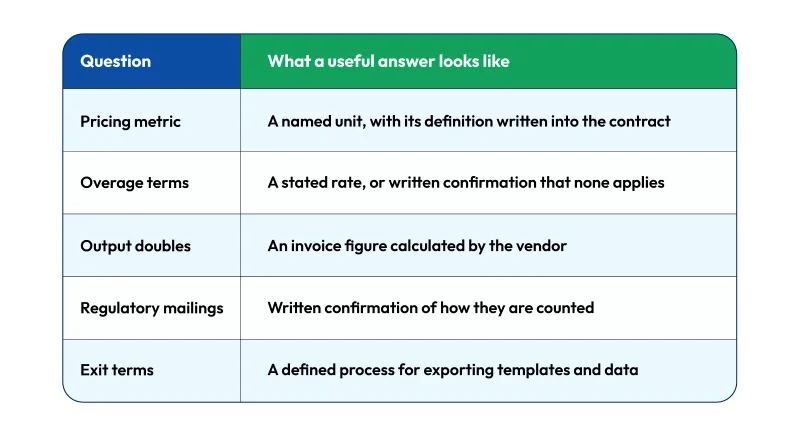
A vendor that answers each of these plainly and writes the answers into the contract gives you software cost you can plan around whatever the sales year brings. If the answers stay vague, weigh that vagueness as heavily as the price.
Check the Meter Before Your Next Big Sales Year
Every policy you write this quarter adds to the meter, and the volume-based CCM pricing drawbacks grow with it. If your contract charges by output, the cost of your best sales year may already be set by terms you signed years ago. A carrier that checks its terms before renewal can plan growth without waiting on an invoice it cannot forecast. Use the checklist above to test your contract today or see how Cincom Eloquence prices without any charge for volume.

See how Cincom Eloquence handles life and annuity communications without charging for volume.
FAQs
1. What makes life and annuity customer communication management different?
A policy produces correspondence at every stage of its life, and every policy in force keeps producing it each year. Annual statements and year-end tax forms for annuity owners also arrive in one heavy cycle.
2. What CCM pricing models can insurance carriers choose from?
Output-based contracts charge per document, per page, per transaction, or by volume tier, so the bill rises with output. Other models set the price on something other than output, so the software cost does not change with volume.
3. How does insurance document generation cost optimization work?
When every output has a price, savings come from sending less. When output carries no fee, the work moves to template design, reusing content across underwriting, claims, and billing, and cutting the errors that force reissued documents.
4. What should I ask a vendor when evaluating enterprise CCM for life insurance?
Ask which unit sets the price, whether overage fees apply, and whether regulatory notices and reissued documents count toward the meter. Then ask the vendor to price your contract at your current volume and at double it.
5. Is volume-based pricing always more expensive?
Not at the start. A quote can look inexpensive while volume is low, and the cost shows up as the book grows.